What is most striking to me about the majority of my finance classes is that theory is not really emphasized, while formulas are of the utmost importance.
I don't want to knock math, per se. However, a lot of what we learn ends up feeling a bit disjointed. Attend a class day after day, where one formula gets listed after another, and it's very easy to lose sight of the bigger picture and get lost in variables.
The formulas largely consist of valuations. Bond valuations, stock valuations, etc. They are immensely important to understand the cost of the capital structure, which is in turn important to understanding how the firm makes expansion decisions.
HOWEVER, our finance classes generally fail to highlight the bigger picture. They also generally fail to move a quick pace, meaning that we don't look at weighted average capital costs until late in the semester, when bad grades and the daily grind have generally sapped all interest. This is exacerbated when we don't look at the psychology of firm decision making and look exclusively at finances.
An improvement I would make? What variables would change the factors involved in the equation? What would change the discount rate, the capitalization rate, the stock growth rate, etc etc.
In my opinion, it would go a long way to making the course seem more "real" and generating interest in introductory finance courses.
Wednesday, September 17, 2008


GSEs and failures
One the big arguments I see coming out against the Fannie Mae bailout among the more "fringe" group of people (IE, the libertarians) is that the Fannie Mae bailout largely wouldn't affect normal people. Since it wouldn't affect normal people, we shouldn't even worry about Fannie...especially because bailing out Fannie requires taxing the normal people!
Leaving aside how the tax burden actually falls on the population by income bracket, let's look at how Fannie interacts with the "real economy."
Fannie's primary purpose is purcahse mortgages from banks, pacakge them into mortgage-backed securities, and sell them to big-time investors. The function is pretty important in the modern economy. Big investors being able to buy simple securities instead of a hodgepodge of loans means capital infusions into residential real estate, meaning basic people can afford to buy loans...especially in an era when Americans themselves don't save much money anymore.
So, eliminating Fannie=making a lot tougher for normal people to get loans, just based on sheer capital available.
But what about liquidity? Fannie provides liquidity to local banks. Rather than having 30 year assets on their balance sheets, banks can instead have money to make more loans, either to other home buyers or to local businesses. This means a greater amount of money being invested back into the community. That means more local barber shops, more local restaraunts, and more local 7-11s. And it's being enabled, in part, by Fannie Mae.
Those are two very real effects that Fannie Mae has on the "real economy."
Hence, yes, Fannie Mae matters to everyone.
But what about the cost?
But who's actually paying, and who's actually benefiting?
For one, common stockholders aren't, and have been entirely wiped out. The people benefiting are China, big investors, and other big banks that bought preferred stock and mortgage-backed securities. Also benefiting is everyone who is buying a home, or possibly thinking of buying a home, or even renters (since more homeowners should mean less competition for rent). IE, everyone kind of benefits. This might be a bias against wealth, since the least wealthy are the ones most likely to be unable to afford higher interest rates. The least wealthy also are hurt the most when the economy slows down.
Who actually pays the tax burden?
Welly, by and large, two thirds is derived from corporations and income taxes. Taxes on corporations largely hurt corporations and those that own stock/bonds most directly. So that's a bias against wealth, on average
Let's look at income taxes.
Look at Page 22
As we can see, the wealthiest, obviously, shoulder most of the tax burden. The lowest 20% pay almost nothing, and the next 40% pay less than $10,000 annually. And that's just in taxes. Using slightly rounded numbers, the bottom 60% shoulder 28.8% of the tax burden, or $58 billion in this plan. Assuming 100 million households, that's a bit shy of $1 grand per household.
I think a one time payment of $1,000 is well worth lower interest rates. ;)
Leaving aside how the tax burden actually falls on the population by income bracket, let's look at how Fannie interacts with the "real economy."
Fannie's primary purpose is purcahse mortgages from banks, pacakge them into mortgage-backed securities, and sell them to big-time investors. The function is pretty important in the modern economy. Big investors being able to buy simple securities instead of a hodgepodge of loans means capital infusions into residential real estate, meaning basic people can afford to buy loans...especially in an era when Americans themselves don't save much money anymore.
So, eliminating Fannie=making a lot tougher for normal people to get loans, just based on sheer capital available.
But what about liquidity? Fannie provides liquidity to local banks. Rather than having 30 year assets on their balance sheets, banks can instead have money to make more loans, either to other home buyers or to local businesses. This means a greater amount of money being invested back into the community. That means more local barber shops, more local restaraunts, and more local 7-11s. And it's being enabled, in part, by Fannie Mae.
Those are two very real effects that Fannie Mae has on the "real economy."
Hence, yes, Fannie Mae matters to everyone.
But what about the cost?
But who's actually paying, and who's actually benefiting?
For one, common stockholders aren't, and have been entirely wiped out. The people benefiting are China, big investors, and other big banks that bought preferred stock and mortgage-backed securities. Also benefiting is everyone who is buying a home, or possibly thinking of buying a home, or even renters (since more homeowners should mean less competition for rent). IE, everyone kind of benefits. This might be a bias against wealth, since the least wealthy are the ones most likely to be unable to afford higher interest rates. The least wealthy also are hurt the most when the economy slows down.
Who actually pays the tax burden?
Welly, by and large, two thirds is derived from corporations and income taxes. Taxes on corporations largely hurt corporations and those that own stock/bonds most directly. So that's a bias against wealth, on average
Let's look at income taxes.
Look at Page 22
As we can see, the wealthiest, obviously, shoulder most of the tax burden. The lowest 20% pay almost nothing, and the next 40% pay less than $10,000 annually. And that's just in taxes. Using slightly rounded numbers, the bottom 60% shoulder 28.8% of the tax burden, or $58 billion in this plan. Assuming 100 million households, that's a bit shy of $1 grand per household.
I think a one time payment of $1,000 is well worth lower interest rates. ;)
Wednesday, September 10, 2008
My own policy positions
In order of importance:
-Health care reform, based on market principles and changing incentives to reduce the amount of unnecessary health care Americans use. Means limiting doctors to fee-for-service, tax credit for health care, and taxation of employee health benefits.
-Education reform, based on stronger federalism principles. National standards on a national test, an individual tax deduction/voucher that can be used at a licensed school system of the parent's choice, and no federal funding for states that don't sign on to the program
-A harder line stance on Iran that includes the application of hard military power
-A sensible withdrawal of the majority of combat troops from Iraq, with the permanent presence in the nation being minimal
-An extension and regularization of the tax credits for solar and wind energy, plus a renewed effort to completely revamp the nation's power grid
-A hard push to add Ukraine and Georgia to NATO
-A reconciliation with Syria
-A broader and more defined economic policy with China, to include obvious rules for improvements with clear punishments defined, in addition to assistance to help China develop its local administration so it can more effectively police its rogue local governments
-A carbon tax on all power and commercial polluters, coupled with increased CAFE standards (over the increase that is already planned)
-A simplified FAFSA form, and simplified financial aid system at the college level to a single form of loan capped at $10,000 annum, indexed at inflation. Simultaneously, the addition of two years of general education to the normal "high school" system.
-GAAP only. No friggin' International accounting standards, regardless of what the SEC suggests
-A raising of income taxes...50% increase at the upper tax bracket, 15% increase for the lower tax brackets. Implementation of a sales tax at the 10% level nationwide. Similarly, the AMT will be abolished.
-No more public housing
-Adjustment of the tax code to eliminate the mortgage tax deduction, instead only allowing only property taxes to be deducted at a to-be-determined percentage rate (not sure if the government already allows deduction of property taxes)
Missing from the list that may be important:
-Increased/decreased military spending
-Social Security Reform
More in-depth thought later, but for a brief moment, let me explain the rationale:
The idea of this reform system to simultaneously address the long-run issues of a globally competitive environment, sustainable public finances, and preventing the erosion of American health.
Hence, the concentration, by and large, is on education and health care reform, both of which are eating away at the incomes of American families. In addition, the tax burden would likely increase significantly under this particular plan (basically everything raises taxes to some extent), but the tax burden is allocated in such a way that it should address other issues too: issues like low savings rates, overinvestment in real estate, externalities of pollution, and malinvestment in the health care sector.
I think it's a bearable plan. ;)
-Health care reform, based on market principles and changing incentives to reduce the amount of unnecessary health care Americans use. Means limiting doctors to fee-for-service, tax credit for health care, and taxation of employee health benefits.
-Education reform, based on stronger federalism principles. National standards on a national test, an individual tax deduction/voucher that can be used at a licensed school system of the parent's choice, and no federal funding for states that don't sign on to the program
-A harder line stance on Iran that includes the application of hard military power
-A sensible withdrawal of the majority of combat troops from Iraq, with the permanent presence in the nation being minimal
-An extension and regularization of the tax credits for solar and wind energy, plus a renewed effort to completely revamp the nation's power grid
-A hard push to add Ukraine and Georgia to NATO
-A reconciliation with Syria
-A broader and more defined economic policy with China, to include obvious rules for improvements with clear punishments defined, in addition to assistance to help China develop its local administration so it can more effectively police its rogue local governments
-A carbon tax on all power and commercial polluters, coupled with increased CAFE standards (over the increase that is already planned)
-A simplified FAFSA form, and simplified financial aid system at the college level to a single form of loan capped at $10,000 annum, indexed at inflation. Simultaneously, the addition of two years of general education to the normal "high school" system.
-GAAP only. No friggin' International accounting standards, regardless of what the SEC suggests
-A raising of income taxes...50% increase at the upper tax bracket, 15% increase for the lower tax brackets. Implementation of a sales tax at the 10% level nationwide. Similarly, the AMT will be abolished.
-No more public housing
-Adjustment of the tax code to eliminate the mortgage tax deduction, instead only allowing only property taxes to be deducted at a to-be-determined percentage rate (not sure if the government already allows deduction of property taxes)
Missing from the list that may be important:
-Increased/decreased military spending
-Social Security Reform
More in-depth thought later, but for a brief moment, let me explain the rationale:
The idea of this reform system to simultaneously address the long-run issues of a globally competitive environment, sustainable public finances, and preventing the erosion of American health.
Hence, the concentration, by and large, is on education and health care reform, both of which are eating away at the incomes of American families. In addition, the tax burden would likely increase significantly under this particular plan (basically everything raises taxes to some extent), but the tax burden is allocated in such a way that it should address other issues too: issues like low savings rates, overinvestment in real estate, externalities of pollution, and malinvestment in the health care sector.
I think it's a bearable plan. ;)
Sunday, August 31, 2008
Experience: Palin and Obama
Before you get riled up, this isn't about whether either candidate is "experienced enough" to sit as President of the United States. That's a long argument that I personally don't want to get into on this blog at the moment. Suffice to say that I do in fact believe that Obama does not yet have the experience necessary to be the leader of the free world, and neither does Palin.
What I am concerned about, though, are Republicans and other McCain-supporters suggesting that Palin's "executive experience" should count for more than Obama's time in Congress. The idea is that executive decision-making is ultimately completely different from legislative decision making, and therefore Palin's experience is more relevant than Obama's.
But is this neccessarily the case?
Don't get me wrong: I would prefer a President to have experience as an executive. That's part of the reason why I supported Mitt Romney in the Republican primaries (though Republicans seemed to prefer McCain instead for some reason!)
Sarah Palin's executive experience, though, is very limited. Her only relevant experience is the governorship of Alaska, but how relevant is that to the United States as a whole?
Let's consider the economy:
Now, let's stop right there. 80% of revenues derived from oil? Alaska's economy more closely resembles a Middle Eastern nation than the United States of America. The lack of diversification makes me wonder how much experience Palin actually has in resolving the various disputes and economic difficulties that the President is going to face.
So, on a major issue (economics) her experience might not be all that relevant.
And what about her foreign policy experience?
Well...uhh...we have no idea if she even has any.
Now contrast this with Barack Obama. While true that he hasn't been directly responsible for the well-being of the entire nation, he has been working in Washington, meaning he has spent the last four years looking at the problems America as a whole is facing directly in the face. So, in fact, he does have some experience with national issues.
Also difficult to gauge is how much wheeling-and-dealing he is doing behind the scenes. Politics is a give-and-take game, relying on compromise, motivating others, and even threatening dissident politicians. In that sense, he also has some experience in negotiating a bureaucracy.
That's two bits of experience that do...sort of qualify Obama to be President. Governor Palin, on the other hand, only has experience with a specialized economy on the fringes of the nation, with no experience in foreign affairs at all.
It's pretty clear who's the winner there, "executive experience" or not.
What I am concerned about, though, are Republicans and other McCain-supporters suggesting that Palin's "executive experience" should count for more than Obama's time in Congress. The idea is that executive decision-making is ultimately completely different from legislative decision making, and therefore Palin's experience is more relevant than Obama's.
But is this neccessarily the case?
Don't get me wrong: I would prefer a President to have experience as an executive. That's part of the reason why I supported Mitt Romney in the Republican primaries (though Republicans seemed to prefer McCain instead for some reason!)
Sarah Palin's executive experience, though, is very limited. Her only relevant experience is the governorship of Alaska, but how relevant is that to the United States as a whole?
Let's consider the economy:
The oil and gas industry dominates the Alaskan economy, with more than 80% of the state's revenues derived from petroleum extraction.
Now, let's stop right there. 80% of revenues derived from oil? Alaska's economy more closely resembles a Middle Eastern nation than the United States of America. The lack of diversification makes me wonder how much experience Palin actually has in resolving the various disputes and economic difficulties that the President is going to face.
So, on a major issue (economics) her experience might not be all that relevant.
And what about her foreign policy experience?
Well...uhh...we have no idea if she even has any.
Now contrast this with Barack Obama. While true that he hasn't been directly responsible for the well-being of the entire nation, he has been working in Washington, meaning he has spent the last four years looking at the problems America as a whole is facing directly in the face. So, in fact, he does have some experience with national issues.
Also difficult to gauge is how much wheeling-and-dealing he is doing behind the scenes. Politics is a give-and-take game, relying on compromise, motivating others, and even threatening dissident politicians. In that sense, he also has some experience in negotiating a bureaucracy.
That's two bits of experience that do...sort of qualify Obama to be President. Governor Palin, on the other hand, only has experience with a specialized economy on the fringes of the nation, with no experience in foreign affairs at all.
It's pretty clear who's the winner there, "executive experience" or not.
Tuesday, August 26, 2008
Make Work, Save the Economy?
One of the ideas that is getting thrown around a lot at the Democratic Convention is the idea that government can automatically provide "high-paying jobs" to our nation's workers through "rebuilding the national infrastructure" and this is a good thing.
The rationale is that many people are out of work, and that the nation needs infrastructure improvements...put the two and two together, and the answer seems perfectly rational! Woo-hoo! Soon we'll be rolling in the dough!
However, by only looking at "save the environment" and "improved roads" and "higher wages," the Democrats are actually missing a big chunk of the picture, namely the fundamentals of economic growth and productivity, hence preventing them from seeing the fact that, in material terms, we will necessarily have to be poorer to carry out their ambitions.
Let's consider the "save the environment" approach. The Democrat approach can be summed up in the Al Gore approach, which aspires to carbon-free electricity within 10 years. The problem here? Massive retooling of the energy industry must be done in order to accomplish this, which requires untold billions of dollars and tearing down a lot of existing infrastructure that's still useful. Hence, retooling the entire energy industry means we are actually destroying wealth rather than creating, and sacrificing other goods in order to pay for the new "green stuff." While it's true we may be better off in the long-run and even in the short run, as we may avert highly damaging global warming and we greatly value clean air, in the direct material sense, we'll be worse off. That means these workers aren't actually producing anything of direct value to the economy. Since the Democrats are touting this as the solution to our economic problems, I am left scratching my head.
The same logic applies, for the most part, to the reconstruction of the nation's roads as well. It isn't actually adding any value to the economy, since it is only maintaining what we already have as opposed to the construction of new roads and railroads to tie the nation together. It's rather hard to justify an economic policy that is based on merely keeping up with where we are right now.
It IS true that government spending can be helpful during a recession (or near recession). Reimbursements can help alleviate some of the pain of economic adjustments, or specific groups in general. Government spending can also be used to manage demand (IE, kick start it) so the economy starts humming again. Government spending is also helpful if it invests projects that provide the essentials for economic growth, like a strong national defense or a power grid.
However, the Democrats are apparently looking at things from a supply-side perspective: they see the falling wages as endemic to the Bush administration era, which encompasses a rather long economic expansion as well as two "recessions." Hence, they don't view their investment program as a simple means to readjust the economy in the aftermath of the credit crunch. Rather, they see this infrastructure investment as a viable solution to an endemic problem (growing economic inequality).
But how much sense does that really make?
The rationale is that many people are out of work, and that the nation needs infrastructure improvements...put the two and two together, and the answer seems perfectly rational! Woo-hoo! Soon we'll be rolling in the dough!
However, by only looking at "save the environment" and "improved roads" and "higher wages," the Democrats are actually missing a big chunk of the picture, namely the fundamentals of economic growth and productivity, hence preventing them from seeing the fact that, in material terms, we will necessarily have to be poorer to carry out their ambitions.
Let's consider the "save the environment" approach. The Democrat approach can be summed up in the Al Gore approach, which aspires to carbon-free electricity within 10 years. The problem here? Massive retooling of the energy industry must be done in order to accomplish this, which requires untold billions of dollars and tearing down a lot of existing infrastructure that's still useful. Hence, retooling the entire energy industry means we are actually destroying wealth rather than creating, and sacrificing other goods in order to pay for the new "green stuff." While it's true we may be better off in the long-run and even in the short run, as we may avert highly damaging global warming and we greatly value clean air, in the direct material sense, we'll be worse off. That means these workers aren't actually producing anything of direct value to the economy. Since the Democrats are touting this as the solution to our economic problems, I am left scratching my head.
The same logic applies, for the most part, to the reconstruction of the nation's roads as well. It isn't actually adding any value to the economy, since it is only maintaining what we already have as opposed to the construction of new roads and railroads to tie the nation together. It's rather hard to justify an economic policy that is based on merely keeping up with where we are right now.
It IS true that government spending can be helpful during a recession (or near recession). Reimbursements can help alleviate some of the pain of economic adjustments, or specific groups in general. Government spending can also be used to manage demand (IE, kick start it) so the economy starts humming again. Government spending is also helpful if it invests projects that provide the essentials for economic growth, like a strong national defense or a power grid.
However, the Democrats are apparently looking at things from a supply-side perspective: they see the falling wages as endemic to the Bush administration era, which encompasses a rather long economic expansion as well as two "recessions." Hence, they don't view their investment program as a simple means to readjust the economy in the aftermath of the credit crunch. Rather, they see this infrastructure investment as a viable solution to an endemic problem (growing economic inequality).
But how much sense does that really make?
Sorry! I've been gone for a while
I haven't posted in a while as Cybernations, a game I play rather extensively, is currently in the midst of a major war. While the war continues, the role I play has shrunken appreciably, and I'll be able to start writing again.
Tuesday, August 5, 2008
Oprah: Worth 1,000,000 Votes
See here
Hat-tip to:
Mankiw
Marginal Revolution
My personal thoughts:
Opinion leadership is very important, but I'm hesitant to think that people are forming opinions just because Oprah is making one. A big factor, as I see it, is the increase in voter participation and voter awareness: getting people to recognize think that the election is important is probably more important than the direct endorsement.
Caution, though: I haven't actually, ya know, READ the paper.
Our results suggest that Winfrey’s endorsement was responsible forapproximately 1,000,000 additional votes for Obama.
Hat-tip to:
Mankiw
Marginal Revolution
My personal thoughts:
Opinion leadership is very important, but I'm hesitant to think that people are forming opinions just because Oprah is making one. A big factor, as I see it, is the increase in voter participation and voter awareness: getting people to recognize think that the election is important is probably more important than the direct endorsement.
Caution, though: I haven't actually, ya know, READ the paper.
Sunday, August 3, 2008
The Death of Doha
The question is, where do we go from here?
Some have suggested that the obvious alternative is bilateral free trade agreements with more nations (even though Congress seems to be putting up stiff resistance to any new deals).
The problem is that this is a bad solution to the problem of global trade reform AND globalization in general.
First, global trade reform. The idea that bilateral trade agreements by the United States are a prescription for global growth problems is a flawed one, because it ignores a lot of the actual and potential trade that plays a big factor in making us all wealthier. The presence of trade barriers between nations in the Third World means that those nations aren't going to be able to realize their full growth potential. The same problem will exist as long as trade barriers exist between Europe and Africa, Russia and China, or any other two individual nations in the world. Eventually, this negative wealth effect acts on us in a perverse trickle down mechanism, sapping our economic potential as well.
Worldwide agreements and organizations like the WTO lower trade barriers globally: it's why the trade talks are so important.
Another important factor: globalized trade talks allows smaller nations to pool their collective demands, much in the same way that unions allow workers to pool their bargaining power. Bilateral agreements allow larger nations to exploit their advantages over poorer nations: it's not surprise, then, that poorer nations aren't so happy about the Doha Round failing.
The effects of trade barriers between other nations and the exploitation of superior bargaining power becomes a LOT more important when you consider the fact that the fastest growing economies are developing ones, and not developed ones.
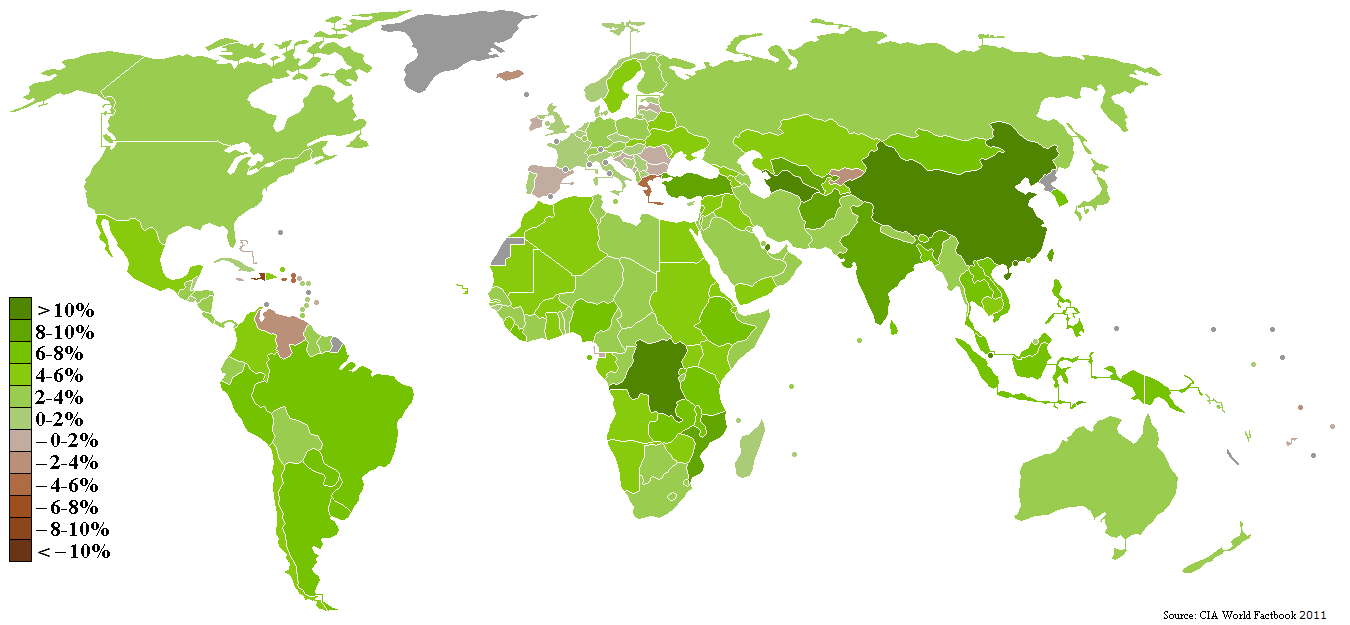
Holding down the growth of the developing world matters. A lot.
Second, globalization encompasses more issues than simple trade. Also included are questions regarding technological implantation, like what standards we should use on the Internet and how to apply child pornography laws. It includes pollution, global financing laws, and weaponization of space as well. Another overlooked issue of globalization? Flows of labor, which presently don't have much of any global regulation whatsoever.
Doha, of course, didn't really address any of these issues. However, what Doha represents is a failure of nations to work together, even when their interests should be, theoretically, mostly aligned (everyone gains from free trade). Such hard-headedness signals bad times for the coming century on the many issues that affect everyone on this planet.
Some have suggested that the obvious alternative is bilateral free trade agreements with more nations (even though Congress seems to be putting up stiff resistance to any new deals).
The problem is that this is a bad solution to the problem of global trade reform AND globalization in general.
First, global trade reform. The idea that bilateral trade agreements by the United States are a prescription for global growth problems is a flawed one, because it ignores a lot of the actual and potential trade that plays a big factor in making us all wealthier. The presence of trade barriers between nations in the Third World means that those nations aren't going to be able to realize their full growth potential. The same problem will exist as long as trade barriers exist between Europe and Africa, Russia and China, or any other two individual nations in the world. Eventually, this negative wealth effect acts on us in a perverse trickle down mechanism, sapping our economic potential as well.
Worldwide agreements and organizations like the WTO lower trade barriers globally: it's why the trade talks are so important.
Another important factor: globalized trade talks allows smaller nations to pool their collective demands, much in the same way that unions allow workers to pool their bargaining power. Bilateral agreements allow larger nations to exploit their advantages over poorer nations: it's not surprise, then, that poorer nations aren't so happy about the Doha Round failing.
The effects of trade barriers between other nations and the exploitation of superior bargaining power becomes a LOT more important when you consider the fact that the fastest growing economies are developing ones, and not developed ones.
Holding down the growth of the developing world matters. A lot.
Second, globalization encompasses more issues than simple trade. Also included are questions regarding technological implantation, like what standards we should use on the Internet and how to apply child pornography laws. It includes pollution, global financing laws, and weaponization of space as well. Another overlooked issue of globalization? Flows of labor, which presently don't have much of any global regulation whatsoever.
Doha, of course, didn't really address any of these issues. However, what Doha represents is a failure of nations to work together, even when their interests should be, theoretically, mostly aligned (everyone gains from free trade). Such hard-headedness signals bad times for the coming century on the many issues that affect everyone on this planet.
Wednesday, July 30, 2008
Court defends "Exorcism"
This is just too insane to be true
Basic background: A 17 year old girl (now 29) was abducted and subjected to a 2-day exorcism, where she was pinned to the ground and "pummeled."
So, she did what any sensible person would do: take her assaulters to court. Lowers court ruled in favor of the girl and awarded her $188,000 in damages. Big ol' Daddy Texas Supreme Court comes along and overturns the ruling, arguing that this is a First Amendment case...therefore it would be unconstitutional for the court to make a ruling on a religious environment. It's not a blank check, mind you: churches can't sexually abuse children. But the trauma caused by this particular religious experience was not considered within the jurisdiction of the court.
She's taking her case to the US Supreme Court.
I definitely think the Texas Court is in the wrong here. While I respect the rights of religions to hold their own spiritual practices and am willing to grant them some leeway on "child abuse" (for example, a child fussing about having to wake up at 7 AM on a Sunday would not be an adequate excuse for government intervention), this exorcism ritual crossed the line. Physical abuse and forceful pinning for days is an obvious abuse: what 17 year old wouldn't be afraid of being constrained by multiple others for an extended period of time?
And if it's obvious abuse, it isn't permissible under the law, just like sexual abuse.
Basic background: A 17 year old girl (now 29) was abducted and subjected to a 2-day exorcism, where she was pinned to the ground and "pummeled."
So, she did what any sensible person would do: take her assaulters to court. Lowers court ruled in favor of the girl and awarded her $188,000 in damages. Big ol' Daddy Texas Supreme Court comes along and overturns the ruling, arguing that this is a First Amendment case...therefore it would be unconstitutional for the court to make a ruling on a religious environment. It's not a blank check, mind you: churches can't sexually abuse children. But the trauma caused by this particular religious experience was not considered within the jurisdiction of the court.
She's taking her case to the US Supreme Court.
I definitely think the Texas Court is in the wrong here. While I respect the rights of religions to hold their own spiritual practices and am willing to grant them some leeway on "child abuse" (for example, a child fussing about having to wake up at 7 AM on a Sunday would not be an adequate excuse for government intervention), this exorcism ritual crossed the line. Physical abuse and forceful pinning for days is an obvious abuse: what 17 year old wouldn't be afraid of being constrained by multiple others for an extended period of time?
And if it's obvious abuse, it isn't permissible under the law, just like sexual abuse.
Tuesday, July 29, 2008
No, Virginia, High Oil Prices are BAD!
Or at least not anywhere near as good as people are implying.
A lot of talk in the media recently has been about the "good side" of high oil prices. For example, a list that a friend recently sent me in an email includes the following "goods" about high gas prices:
And the most recent Businessweek?
http://www.businessweek.com/magazine/content/08_31/b4094000658012.htm?chan=magazine+channel_top+stories
The basic idea is pretty simple: low oil prices in the past cause all sorts of bad things that we don't like, such as childhood obesity, reliance on foreign oil, outsourcing of jobs, etc. Since oil prices are now high, people can exercise more, cut back on "frivolous consumption," develop alternatives to oil, and develop public transportation networks.
Don't get me wrong. Oil prices in the 1990s were probably too low. Hell, they are probably too low NOW: the price of gasoline still doesn't include the environmental damage it causes. But that's due to the externalities of oil prices...and, like I just said, the externalities still existed. Other than that, everything represented fundamentals.
When it comes to a good with a price determined exclusively by fundamentals and where the private cost is the total cost of the good (IE, a perfectly competitive market with no externalities), more is ALWAYS better. We call those "supply-side shifts." And as any econ 101 student can tell you, supply side shifts mean more goods at lower prices. People don't care so much about being obese, having awesome public transit, or supplying foreign nations with dollars: they are far, far more concerned about having cheap gasoline. They WANT cheap gasoline.
Or, just take a look at those most hurt by the high gasoline prices: the poor. They cannot afford new hybrid cars, they are not located near public transit, and they can't cut back much on their own driving. It's precisely the reason why economists say that energy taxes need to be paired with lump sum rebates especially targeted towards those with low income: people with low income are hurt worse when gas prices rise.
So, what do we really want? We want cheap oil. What would be REALLY awesome if we had cheap oil that didn't negatively affect the environment. And doesn't that make sense? More of good stuff=good.
A lot of talk in the media recently has been about the "good side" of high oil prices. For example, a list that a friend recently sent me in an email includes the following "goods" about high gas prices:
1. Globalized Jobs Return Home
2. Sprawl Stalls - 'Across the country, real estate agents are reporting that many home buyers are looking to move closer to cities. Gas prices are shaping their decisions.' -- Did you not call for an increase in population density at one point?
3. Four-Day Workweeks
4. Less pollution -- heart of the matter
5. More Frugality – 'We're all wasting less.' – Also advocated by WFan.
6. Fewer Traffic Deaths
7. Cheaper Insurance
8. Less Traffic
9. More Cops on the Beat
10. Less Obesity
And the most recent Businessweek?
http://www.businessweek.com/magazine/content/08_31/b4094000658012.htm?chan=magazine+channel_top+stories
The Real Question: Should Oil Be Cheap?
Expensive oil hurts, but there's a business case to be made for a floor under the price of crude
The basic idea is pretty simple: low oil prices in the past cause all sorts of bad things that we don't like, such as childhood obesity, reliance on foreign oil, outsourcing of jobs, etc. Since oil prices are now high, people can exercise more, cut back on "frivolous consumption," develop alternatives to oil, and develop public transportation networks.
Don't get me wrong. Oil prices in the 1990s were probably too low. Hell, they are probably too low NOW: the price of gasoline still doesn't include the environmental damage it causes. But that's due to the externalities of oil prices...and, like I just said, the externalities still existed. Other than that, everything represented fundamentals.
When it comes to a good with a price determined exclusively by fundamentals and where the private cost is the total cost of the good (IE, a perfectly competitive market with no externalities), more is ALWAYS better. We call those "supply-side shifts." And as any econ 101 student can tell you, supply side shifts mean more goods at lower prices. People don't care so much about being obese, having awesome public transit, or supplying foreign nations with dollars: they are far, far more concerned about having cheap gasoline. They WANT cheap gasoline.
Or, just take a look at those most hurt by the high gasoline prices: the poor. They cannot afford new hybrid cars, they are not located near public transit, and they can't cut back much on their own driving. It's precisely the reason why economists say that energy taxes need to be paired with lump sum rebates especially targeted towards those with low income: people with low income are hurt worse when gas prices rise.
So, what do we really want? We want cheap oil. What would be REALLY awesome if we had cheap oil that didn't negatively affect the environment. And doesn't that make sense? More of good stuff=good.
Monday, July 28, 2008
So, ARE boys better than girls at math?
Sometimes, I really don't have to write a thing!
The answer: that's not the question you should be asking.
Rather, you should be asking how the skill level of boys and girls varies by person. If there is a difference in variance, then it means one group will be producing more geniuses (and idiots) than the other. Since certain jobs require a LOT of intelligence, it means that one gender will be over-represented in that field.
Thursday, July 24, 2008
Career Education in the United States
Full Report Here
Here's an interesting bit: we know that more women than men are going to college these days.
Did you know they also are more likely to get additional education when out in the work force?
Here's an interesting bit: we know that more women than men are going to college these days.
Did you know they also are more likely to get additional education when out in the work force?
Higher rates of participation in work-related coursetaking were also observed for (female) than for male adult labor force members in 2004–05 (44 vs. 31 percent)
Scariest sentence this morning
The White House, citing an urgent need to restore market confidence in the two mortgage giants, Fannie Mae and Freddie Mac, said President Bush would sign the measure despite his opposition to the inclusion of nearly $4 billion in grants for local governments to buy and refurbish foreclosed properties.
Why in the world could you oppose that?
Taken from the NY Times article on the Housing Bill
Wednesday, July 23, 2008
Echo Chambers and the Modern World
You know what an echo chamber is? It's where you say something, and all the room does reverbate the sound of your own voice back to you. It's pretty kickass if, like myself, you like the sound of your own voice. Most people seem not to (and I didn't before I got a radio show in high school). But that's another story for another a day.
A lot of us live in a certain kind of echo chamber in our everyday lives, though. The CEO who surrounds himself with nothing but "yes men" only hears his/her ideas echoed back to him. Teachers who conduct anti-drug or pro-abstinence seminars often have the same phenomena with their students...5 minutes before the alpha dog slaps on a condom to have sex with the rebel "slutty" girl while sparking up a Marlboro (and he's 14!).
And a lot of us have similar information echo chambers. If you're a right-wing conservative and you tune in to Fox News, chances are you are only hearing your own ideas back bounce at you. A very similar thing occurs if you're a liberal who relies on DailyKOS for all of your information.
The problem with an echo chamber is that people who discuss their ideas tend to start out a bit moderate with a slight leaning in one direction or another. Since they only encounter arguments from their own side, they tend to get very confident in their beliefs, and grow more extreme. If you're a conservative and turn on Rush Limbaugh thinking that welfare is a bad idea, you'll probably turn off the radio thinking that welfare is the WORST IDEA EVAH and that anyone who supports it is an obvious dummy at best, and pandering for the black vote at worst.
A curious effect might be that the most politically active of us become the most polarized of us, at least if we are more likely to look to sources that share our beliefs. The politically active among us talk about the issues, go to their respective echo chambers, and come away bloodthirsty radicals that want change and want it NOW. What can possibly moderate this?!
Well, it ain't the real estate market, that's for sure. See here:
Americans, with higher incomes and more mobility, can increasingly choose where to live, and they can make a lot more choices than they used to be able to. Since people like living around like-mindeds, they create clusters of red and blue zones. And the effect magnifies the echo chambers...especially among those who care most about politics.
Heck, politics even seems to matter when we choose who we marry, though I can't find a link for it at the moment.
Echo chambers. So very cool.
But so very dangerous.
This post borrows heavily from the writings of Cass Sunstein, particularly Infotopia. A very good read. :)
A lot of us live in a certain kind of echo chamber in our everyday lives, though. The CEO who surrounds himself with nothing but "yes men" only hears his/her ideas echoed back to him. Teachers who conduct anti-drug or pro-abstinence seminars often have the same phenomena with their students...5 minutes before the alpha dog slaps on a condom to have sex with the rebel "slutty" girl while sparking up a Marlboro (and he's 14!).
And a lot of us have similar information echo chambers. If you're a right-wing conservative and you tune in to Fox News, chances are you are only hearing your own ideas back bounce at you. A very similar thing occurs if you're a liberal who relies on DailyKOS for all of your information.
The problem with an echo chamber is that people who discuss their ideas tend to start out a bit moderate with a slight leaning in one direction or another. Since they only encounter arguments from their own side, they tend to get very confident in their beliefs, and grow more extreme. If you're a conservative and turn on Rush Limbaugh thinking that welfare is a bad idea, you'll probably turn off the radio thinking that welfare is the WORST IDEA EVAH and that anyone who supports it is an obvious dummy at best, and pandering for the black vote at worst.
A curious effect might be that the most politically active of us become the most polarized of us, at least if we are more likely to look to sources that share our beliefs. The politically active among us talk about the issues, go to their respective echo chambers, and come away bloodthirsty radicals that want change and want it NOW. What can possibly moderate this?!
Well, it ain't the real estate market, that's for sure. See here:
Americans are increasingly forming like-minded clusters. Conservatives are choosing to live near other conservatives, and liberals near liberals.
A good way to measure this is to look at the country's changing electoral geography. In 1976 Jimmy Carter won the presidency with 50.1% of the popular vote. Though the race was close, some 26.8% of Americans were in “landslide counties” that year, where Mr Carter either won or lost by 20 percentage points or more.
Americans, with higher incomes and more mobility, can increasingly choose where to live, and they can make a lot more choices than they used to be able to. Since people like living around like-mindeds, they create clusters of red and blue zones. And the effect magnifies the echo chambers...especially among those who care most about politics.
Heck, politics even seems to matter when we choose who we marry, though I can't find a link for it at the moment.
Echo chambers. So very cool.
But so very dangerous.
This post borrows heavily from the writings of Cass Sunstein, particularly Infotopia. A very good read. :)
Why Poor Nations are Poor
Why? What we all agree upon
It's one of the biggest questions of the modern world: why are Western Europe, the United States, Japan, and certain British dominions so wealthy, while the rest of the world is so damn poor?
The answer largely depends on who you ask. If you ask a die-hard libertarian, its because the poor world did not embrace markets, whereas the wealthy Europeans have had a more...sophisticated respect for capitalism. A die-hard liberal might point to oppression and exploitation by the West, while more moderates might suggest that institutions (financial markets, democracy, allowing interest payments, etc) allowed the West to gain incredible amounts of wealth.
But we can all point to one point in history where the West started to take off: the industrial revolution. Starting in England and slowly migrating to other parts of Europe, the Industrial Revolution created incredible wealth, while most of the world has only recently begun industrializing.
So, we have our opinions colored by this industrial revolution. Economy policy prescriptions seem largely based on what we think allowed said industrial revolution occurred, which has largely been a rigorous treatment of markets, political reform, and the establishment of new economic institutions.
But, what exactly defined the Industrial Revolution?
A lot of people suggest that it is the development of new technologies, which allowed factories to be built as production was more advanced. Hence, we tend to think of the Industrial Revolution as being relatively capital-intensive: heck, just listen to the communists rant about capital and the means of production. Hence, we consider the development of industry and manufacture to be an essential part of economic development. Because of this, we tend to look at things like tariffs as being an essential part of early development, because it allows domestic industry to develop.
Gentlemen (and whatever ladies we have), this is poppycosh. It is true that capital stores have been enhanced somewhat since the beginning of the industrial revolution. It is not, however, true that the industrial revolution was primarily about industry, and that nations that developed heavy industry were the ones that ended up being the wealthiest by some inevitable process.
Why we buy capital
Capital reserves are based on two things: the real interest rate and the returns to capital. Much like supply and demand must equal each other, so must the interest rate equal the return to capital. If you are going to spend $1,000,000 on building a giant new factory, and earn $50,000 over the life of the factory (or 5%), you'll only build the factory if the interest rate during the same period of time is equal to or less than 5%. Otherwise, you'd invest your money instead of building a factory.
Real interest rates in England at the time of the Industrial Revolution were already relatively low, relative to those of the rest of Europe and of Asia. Declines in real interest rates are not the primary factor driving the industrial revolution. Therefore, we have to point to returns...
But why did returns suddenly increase? Is it, as some people suggest, England levied protective tariffs? Perhaps this is A factor, but probably not the primary one. The textile industry (which produced roughly half the gains England experienced in the early Industrial Revolution) was a highly competitive industry within England, since the optimum size of a textile plant was very small. Hence, returns to capital were low, as profits were very low.
Technology? Definitely the case, along with other innovations. Efficiency gains make the production possibilities increase, and also increase the returns to capital. Hence, there's a rush to buy MORE capital after a new technology comes out that makes spinning threads easier.
You might be thinking that I have just disproved my point. Au Contraire. Keep reading
Globalization in the Late Industrial Age
At first, England tried very hard to protect its markets, as well as keep technology within its own borders. This proved impossible, and technology slowly leaked to other nations around the world. Similarly, England steadily lowered its tariffs (in contrast to, say, France, where tariffs were low throughout to the 19th century).
Great Britain also committed itself to a policy of free markets and free® trade, and other European nations were also committed to building essential railroads within its colonies in order to safeguard gains. Hence, by the time the late 1800s rolled around, the world was surprisingly well-integrated. The globalization of the 1870-1914 era is hard to understate. This is largely the result of the two World Wars: if the economy was so well-integrated, why would the nations of the world fight each other? This is another question for another time, but suffice to say that trade compromised a large part of most European economies at the time. Exports and imports accounted for something like half of the French economy in 1914, compared to 54% of the French economy today. And Germany was the biggest trade partner in 1914, just as it is today.
The developing world was also well-integrated, at least for global capital markets. We can see this in the interest rate between nations at this time, which have absolutely nothing to do with income: India's interest rates were actually lower than those of the United States. India had access to all the capital she would ever need, and all the technology that her European peers had. Because of this, Indian railroads (which were subsidized by the Indian government) were actually better constructed than American railroads.
Yet, India did not develop. Nor did Africa, nor did the Ottoman Empire. In contrast, the United States, plagued by monopolies, corruption, and relatively BAD capital markets, did develop. What gives?
Efficiency: Not Just Technology
As previously stated, efficiency gains explain why countries would purchase more capital. What I did not mention is that efficiency gains also explain a large portion of economic growth in and of themselves (75% or more).
Efficiency, however, is not merely new production technology. I could give a group of three year olds access to a nuclear reactor, and they would be unable to produce even a watt of electricity. Technology means nothing if you can't utilize it properly, and that was the difficulty that less developed nations had. For instance, a textile mill in India would have 1 worker per loom. In contrast, a British or American loom would typically have 1 worker service 8 looms at once. Hence, productivity per worker was far higher in the developed world, and wages/income were higher as a result.
Intangible are things we undervalue greatly today. In part, this is the fault of economists, who concentrate largely on maximization and equilibrium rather than the spread of ideas. Yet, these intangibles are largely the reason why the West is developed today, while the rest of the world has not developed.
Hence, the American South, which had very little industrialization at all, would've rated as the world's 4th richest nation in 1860. Nations can make a fine dollar by exporting something that is not considered an industrial staple, as the general increase of wealth increases demand, and the nation can increase its own supply side through alternative means.
What intangibles are important
Of this, I am less than certain. "A Farewell to Alms," which this post is heavily based off of, suggests that labor quality in the undeveloped world was far inferior to that of the developed world. The example used, though, is hardly conclusive, and might be construed as inept management.
Labor quality probably was, however, inferior, just as it remains inferior today. Similarly, the undeveloped world did not have a core of entrepreneurs and experienced managers, unlike the developed world. This is highly important, as importing management is not as easy as it seems (the soft skills of a manager matter greatly). The lack of entrepreneurs might in turn be the result of lower literacy levels and the low social status of merchants in such times, whereas business became the playground of literate Samurai in Japan. (Indeed, literacy levels in India remain relatively low, barely higher than levels in 1700s England).
Prescription
So, if we want to increase wealth in the developing world, what should we do?
First off, stop dumping aid on them. It doesn't actually increase their living standards. If anything, it actually REDUCES living standards, because parts of the world remain in a Malthusian trap. Any increase in resources(particularly medicine) actually reduces living standards.
Rather, we should focus on the intangibles of growth. That means discipline in the workplace. It means a strong respect for entrepreneurship, and higher literacy and experience in managing businesses. It also means more focus on how different societies operate, so that managers can make most effective use of their work face.
What am I not prescribing? I am not talking about democracy. I am not talking about free trade or free flow of capital. I am not suggesting high tariffs. Certainly, to some extent, these things are actually helpful (in fact, the reintroduction of globalization in the 1970s and 1980s probably set the stage for growth in India and China after they had experienced large growth in literacy and bureaucratization from their statist governments. Ironically, their socialist governments might have done an absolutely remarkable job in preparing them for the capitalist world). They are not, however, sufficient conditions.
It's one of the biggest questions of the modern world: why are Western Europe, the United States, Japan, and certain British dominions so wealthy, while the rest of the world is so damn poor?
The answer largely depends on who you ask. If you ask a die-hard libertarian, its because the poor world did not embrace markets, whereas the wealthy Europeans have had a more...sophisticated respect for capitalism. A die-hard liberal might point to oppression and exploitation by the West, while more moderates might suggest that institutions (financial markets, democracy, allowing interest payments, etc) allowed the West to gain incredible amounts of wealth.
But we can all point to one point in history where the West started to take off: the industrial revolution. Starting in England and slowly migrating to other parts of Europe, the Industrial Revolution created incredible wealth, while most of the world has only recently begun industrializing.
So, we have our opinions colored by this industrial revolution. Economy policy prescriptions seem largely based on what we think allowed said industrial revolution occurred, which has largely been a rigorous treatment of markets, political reform, and the establishment of new economic institutions.
But, what exactly defined the Industrial Revolution?
A lot of people suggest that it is the development of new technologies, which allowed factories to be built as production was more advanced. Hence, we tend to think of the Industrial Revolution as being relatively capital-intensive: heck, just listen to the communists rant about capital and the means of production. Hence, we consider the development of industry and manufacture to be an essential part of economic development. Because of this, we tend to look at things like tariffs as being an essential part of early development, because it allows domestic industry to develop.
Gentlemen (and whatever ladies we have), this is poppycosh. It is true that capital stores have been enhanced somewhat since the beginning of the industrial revolution. It is not, however, true that the industrial revolution was primarily about industry, and that nations that developed heavy industry were the ones that ended up being the wealthiest by some inevitable process.
Why we buy capital
Capital reserves are based on two things: the real interest rate and the returns to capital. Much like supply and demand must equal each other, so must the interest rate equal the return to capital. If you are going to spend $1,000,000 on building a giant new factory, and earn $50,000 over the life of the factory (or 5%), you'll only build the factory if the interest rate during the same period of time is equal to or less than 5%. Otherwise, you'd invest your money instead of building a factory.
Real interest rates in England at the time of the Industrial Revolution were already relatively low, relative to those of the rest of Europe and of Asia. Declines in real interest rates are not the primary factor driving the industrial revolution. Therefore, we have to point to returns...
But why did returns suddenly increase? Is it, as some people suggest, England levied protective tariffs? Perhaps this is A factor, but probably not the primary one. The textile industry (which produced roughly half the gains England experienced in the early Industrial Revolution) was a highly competitive industry within England, since the optimum size of a textile plant was very small. Hence, returns to capital were low, as profits were very low.
Technology? Definitely the case, along with other innovations. Efficiency gains make the production possibilities increase, and also increase the returns to capital. Hence, there's a rush to buy MORE capital after a new technology comes out that makes spinning threads easier.
You might be thinking that I have just disproved my point. Au Contraire. Keep reading
Globalization in the Late Industrial Age
At first, England tried very hard to protect its markets, as well as keep technology within its own borders. This proved impossible, and technology slowly leaked to other nations around the world. Similarly, England steadily lowered its tariffs (in contrast to, say, France, where tariffs were low throughout to the 19th century).
Great Britain also committed itself to a policy of free markets and free® trade, and other European nations were also committed to building essential railroads within its colonies in order to safeguard gains. Hence, by the time the late 1800s rolled around, the world was surprisingly well-integrated. The globalization of the 1870-1914 era is hard to understate. This is largely the result of the two World Wars: if the economy was so well-integrated, why would the nations of the world fight each other? This is another question for another time, but suffice to say that trade compromised a large part of most European economies at the time. Exports and imports accounted for something like half of the French economy in 1914, compared to 54% of the French economy today. And Germany was the biggest trade partner in 1914, just as it is today.
The developing world was also well-integrated, at least for global capital markets. We can see this in the interest rate between nations at this time, which have absolutely nothing to do with income: India's interest rates were actually lower than those of the United States. India had access to all the capital she would ever need, and all the technology that her European peers had. Because of this, Indian railroads (which were subsidized by the Indian government) were actually better constructed than American railroads.
Yet, India did not develop. Nor did Africa, nor did the Ottoman Empire. In contrast, the United States, plagued by monopolies, corruption, and relatively BAD capital markets, did develop. What gives?
Efficiency: Not Just Technology
As previously stated, efficiency gains explain why countries would purchase more capital. What I did not mention is that efficiency gains also explain a large portion of economic growth in and of themselves (75% or more).
Efficiency, however, is not merely new production technology. I could give a group of three year olds access to a nuclear reactor, and they would be unable to produce even a watt of electricity. Technology means nothing if you can't utilize it properly, and that was the difficulty that less developed nations had. For instance, a textile mill in India would have 1 worker per loom. In contrast, a British or American loom would typically have 1 worker service 8 looms at once. Hence, productivity per worker was far higher in the developed world, and wages/income were higher as a result.
Intangible are things we undervalue greatly today. In part, this is the fault of economists, who concentrate largely on maximization and equilibrium rather than the spread of ideas. Yet, these intangibles are largely the reason why the West is developed today, while the rest of the world has not developed.
Hence, the American South, which had very little industrialization at all, would've rated as the world's 4th richest nation in 1860. Nations can make a fine dollar by exporting something that is not considered an industrial staple, as the general increase of wealth increases demand, and the nation can increase its own supply side through alternative means.
What intangibles are important
Of this, I am less than certain. "A Farewell to Alms," which this post is heavily based off of, suggests that labor quality in the undeveloped world was far inferior to that of the developed world. The example used, though, is hardly conclusive, and might be construed as inept management.
Labor quality probably was, however, inferior, just as it remains inferior today. Similarly, the undeveloped world did not have a core of entrepreneurs and experienced managers, unlike the developed world. This is highly important, as importing management is not as easy as it seems (the soft skills of a manager matter greatly). The lack of entrepreneurs might in turn be the result of lower literacy levels and the low social status of merchants in such times, whereas business became the playground of literate Samurai in Japan. (Indeed, literacy levels in India remain relatively low, barely higher than levels in 1700s England).
Prescription
So, if we want to increase wealth in the developing world, what should we do?
First off, stop dumping aid on them. It doesn't actually increase their living standards. If anything, it actually REDUCES living standards, because parts of the world remain in a Malthusian trap. Any increase in resources(particularly medicine) actually reduces living standards.
Rather, we should focus on the intangibles of growth. That means discipline in the workplace. It means a strong respect for entrepreneurship, and higher literacy and experience in managing businesses. It also means more focus on how different societies operate, so that managers can make most effective use of their work face.
What am I not prescribing? I am not talking about democracy. I am not talking about free trade or free flow of capital. I am not suggesting high tariffs. Certainly, to some extent, these things are actually helpful (in fact, the reintroduction of globalization in the 1970s and 1980s probably set the stage for growth in India and China after they had experienced large growth in literacy and bureaucratization from their statist governments. Ironically, their socialist governments might have done an absolutely remarkable job in preparing them for the capitalist world). They are not, however, sufficient conditions.
Sunday, July 20, 2008
DIFFERING VIEWPOINTS #1: Fannie Mae and Freddie Mac
Unless you've been living under a rock, you probably know that Freddie Mac and Fannie Mae are probably going to join the long list of companies that have had government bailouts. You know, along with the S&Ls, the airline industry, etc. etc...
The problem, many believe, is that private companies should not have government bailouts....ever. Firstly, it's immoral: private corporations shouldn't be getting money from the government. The logic behind this is obvious. People who invest in corporations are naturally taking an obvious risky option, and the people who own major corporations are (presumably) the wealthy. Why pay off a bunch of rich people because they screwed up?
The second argument is a more practical argument. When Freddie and Fannie do well, the stockholders reap all the profits. When Freddie and Fannie do bad, the taxpayer is left holding the bag. Socialized costs and private benefits, it is argued, tend to lead to excesses. If I lose little of my own money, and but get all the rewards if I win, I'm going to be taking a lot of risky actions.
So, bailouts are bad.
The second bit is the logic one of my friends uses in his argument, in one of the companion pieces to this post. You can see the whole thing here
However, I disagree with both of the above points...at least to some degree.
In the first: Increasingly,, regular people are owners of equity. It's not just Warren Buffet who gets hurt when the Dow Jones tumbles 2,000 points. It's also your neighbors and the California teachers. This doesn't necessarily mean that it's right to bail out companies in order to buoy stock prices. After all, we could still help those people out through other means (liberals would argue, perhaps, by increasing social security benefits). But it's something to consider...at least if only to recognize that, when the financial market gets hit, everyone else hurts too.
In the second, as Krugman points out, Freddie and Fannie weren't the ones innovating in high-risk securities. That's those "other" companies, like Bear Stearns, Countrywide, etc etc. You know...those other guys that are getting bought out.
That's because Freddie and Fannie were highly regulated in addition to having an assurance of a government bailout. So, they only were investing in relatively safe loans. It looked like a bad bet when everyone was making money in the 90s and the early millennium...doesn't seem too stupid now.
However, even Freddie and Fannie are getting hurt...but that's because the whole system is hurting:
That, in addition to the fact that Freddie and Fannie were pressured to start making near-subprime loans after the private sector started failing, meant that they weren't in all too great a shape. And that's because everyone else screwed up, not Freddie and Fannie. It's a great example of how everyone is connected.
But, there are SOME inherent problems with the two giant mortgage companies. The companies generally have too little capital on hand. Part of the point of having them be semi-private companies is that they could raise capital buy selling stock, hence being somewhat independent of the government.
Still, though, the government bailout isn't showing how Freddie and Fannie have failed. It's showing how regulation in the financial industry has failed.
The problem, many believe, is that private companies should not have government bailouts....ever. Firstly, it's immoral: private corporations shouldn't be getting money from the government. The logic behind this is obvious. People who invest in corporations are naturally taking an obvious risky option, and the people who own major corporations are (presumably) the wealthy. Why pay off a bunch of rich people because they screwed up?
The second argument is a more practical argument. When Freddie and Fannie do well, the stockholders reap all the profits. When Freddie and Fannie do bad, the taxpayer is left holding the bag. Socialized costs and private benefits, it is argued, tend to lead to excesses. If I lose little of my own money, and but get all the rewards if I win, I'm going to be taking a lot of risky actions.
So, bailouts are bad.
The second bit is the logic one of my friends uses in his argument, in one of the companion pieces to this post. You can see the whole thing here
However, I disagree with both of the above points...at least to some degree.
In the first: Increasingly,, regular people are owners of equity. It's not just Warren Buffet who gets hurt when the Dow Jones tumbles 2,000 points. It's also your neighbors and the California teachers. This doesn't necessarily mean that it's right to bail out companies in order to buoy stock prices. After all, we could still help those people out through other means (liberals would argue, perhaps, by increasing social security benefits). But it's something to consider...at least if only to recognize that, when the financial market gets hit, everyone else hurts too.
In the second, as Krugman points out, Freddie and Fannie weren't the ones innovating in high-risk securities. That's those "other" companies, like Bear Stearns, Countrywide, etc etc. You know...those other guys that are getting bought out.
That's because Freddie and Fannie were highly regulated in addition to having an assurance of a government bailout. So, they only were investing in relatively safe loans. It looked like a bad bet when everyone was making money in the 90s and the early millennium...doesn't seem too stupid now.
However, even Freddie and Fannie are getting hurt...but that's because the whole system is hurting:
In Los Angeles, Miami and other places, anyone who borrowed to buy a house at the peak of the market probably has negative equity at this point, even if he or she originally put 20 percent down. The result is a rising rate of delinquency even on loans that meet Fannie-Freddie guidelines.
That, in addition to the fact that Freddie and Fannie were pressured to start making near-subprime loans after the private sector started failing, meant that they weren't in all too great a shape. And that's because everyone else screwed up, not Freddie and Fannie. It's a great example of how everyone is connected.
But, there are SOME inherent problems with the two giant mortgage companies. The companies generally have too little capital on hand. Part of the point of having them be semi-private companies is that they could raise capital buy selling stock, hence being somewhat independent of the government.
Still, though, the government bailout isn't showing how Freddie and Fannie have failed. It's showing how regulation in the financial industry has failed.
Monday, July 14, 2008
Union of the Mediterranean
While the focus of this article is on France bringing Syria out of diplomatic isolation and back to reengagement with the West.
What I'm surprised by....
Why didn't Libya attend the meeting? A nation can't possibly reintegrate into the world if it refuses to talk to its neighbors about issues as simple as students visas and pollution management.
Sunday, July 13, 2008
Should we all be learning second languages?
Senator Obama seems to think so, apparently
My question to those who say we should be learning foreign languages, since everyone else is taking the trouble to learn ours...
Okay, which ones?
German? We still trade plenty with Germany, and even import weapons
Spanish? Got a lot of immigrants coming in from all over Latin America
Japan? That's where we get our high tech stuff right?
Vietnamese and Korean? I mean...we get video games from there...right?
Thai?
Mandarin?
English has been chosen as a global language. Really, us learning foreign languages simply isn't as essential as foreigners learning English. Even if we wanted to be global wine/book/whatever connoisseurs, we couldn't possibly succeed: There are too many languages to learn!
My question to those who say we should be learning foreign languages, since everyone else is taking the trouble to learn ours...
Okay, which ones?
German? We still trade plenty with Germany, and even import weapons
Spanish? Got a lot of immigrants coming in from all over Latin America
Japan? That's where we get our high tech stuff right?
Vietnamese and Korean? I mean...we get video games from there...right?
Thai?
Mandarin?
English has been chosen as a global language. Really, us learning foreign languages simply isn't as essential as foreigners learning English. Even if we wanted to be global wine/book/whatever connoisseurs, we couldn't possibly succeed: There are too many languages to learn!
Saturday, July 12, 2008
The Anarchist Misconception
There are a LOT of young anarchists. A LOT. Like, if you wander around an internet forum or a college campus with the big red “A,” you’re almost guaranteed to have some random weirdo walk up to you and deliver a sweaty high five right into your palm…and if you’re lucky, he might even offer you a joint!
These people are generally classified under one of two belief systems:
1. For any given society, they are better off without a government than with a government
2. By changing cultural norms, they can eliminate most of the needs for governments
They promise that things will be better with no government, and point to all the terrible things that governments have done since the beginning of human history. They have supported slavery, extorted massive amounts of wealth from citizens, protected negligent and polluting companies, started pointless wars, etc etc.
Governments, in their view, are mostly bad things that people use to oppress others. We’d be better off without them.
Unfortunately, I find this to be an argument that really doesn’t appreciate how much government has changed since the industrial revolution (and, indeed, just the past 50 years!)
Liberal democracies generally do not assault their citizens, or even citizens of foreign nations. Indeed, they are highly dedicated to international institutions, foreign aid, and providing healthcare and education to their citizens. Obviously, this might piss off a libertarian (who sees government as slowly encroaching on all areas of life), but it should demonstrate to most other people that government is NOT intent on screwing people over anymore.
It might be incompetent.
It might be mean sometimes.
It might overstep boundaries occasionally (see waterboarding).
But the government is NOT evil. At least not by intent.
The typical retort is that government, even if it isn’t bad NOW, will probably revert back to a horde of evil, barbaric Roman conquistadors. It is, after all, the way of government!
However, this really ignores how much history has changed. Back before the industrial age, the only way to make a quick buck was to steal it in some fashion. In this era, looting is not profitable, nor is it easy to do in an era where guns are so prevalent and liberal democracies don’t permit doing bad things to foreign countries anymore.
So, I really don’t see the return of “evil government.”
But, they say, doesn’t that mean that people are already good, and that government is superfluous? After all, good people don’t need government, and bad people wouldn’t be capable of making good government…
Perhaps. But we’ve turned a new leaf in how we rule ourselves, and a lot of anarchists don’t seem to accept that. That’s the main problem I have with them.
These people are generally classified under one of two belief systems:
1. For any given society, they are better off without a government than with a government
2. By changing cultural norms, they can eliminate most of the needs for governments
They promise that things will be better with no government, and point to all the terrible things that governments have done since the beginning of human history. They have supported slavery, extorted massive amounts of wealth from citizens, protected negligent and polluting companies, started pointless wars, etc etc.
Governments, in their view, are mostly bad things that people use to oppress others. We’d be better off without them.
Unfortunately, I find this to be an argument that really doesn’t appreciate how much government has changed since the industrial revolution (and, indeed, just the past 50 years!)
Liberal democracies generally do not assault their citizens, or even citizens of foreign nations. Indeed, they are highly dedicated to international institutions, foreign aid, and providing healthcare and education to their citizens. Obviously, this might piss off a libertarian (who sees government as slowly encroaching on all areas of life), but it should demonstrate to most other people that government is NOT intent on screwing people over anymore.
It might be incompetent.
It might be mean sometimes.
It might overstep boundaries occasionally (see waterboarding).
But the government is NOT evil. At least not by intent.
The typical retort is that government, even if it isn’t bad NOW, will probably revert back to a horde of evil, barbaric Roman conquistadors. It is, after all, the way of government!
However, this really ignores how much history has changed. Back before the industrial age, the only way to make a quick buck was to steal it in some fashion. In this era, looting is not profitable, nor is it easy to do in an era where guns are so prevalent and liberal democracies don’t permit doing bad things to foreign countries anymore.
So, I really don’t see the return of “evil government.”
But, they say, doesn’t that mean that people are already good, and that government is superfluous? After all, good people don’t need government, and bad people wouldn’t be capable of making good government…
Perhaps. But we’ve turned a new leaf in how we rule ourselves, and a lot of anarchists don’t seem to accept that. That’s the main problem I have with them.
Thursday, July 10, 2008
They're all a bunch of whiners!
Or, at least we are according to Phil Graham.
Now, I don't know too much about Senator Graham, so I am going to have to guess a bit. I'm guessing that, since he's the economic adviser to John McCain, he's REALLY keen on the market, and really keen on trying to show the recent economic performance as pretty strong (since a Republican is in office after implementing sizable tax cuts, which is the bedrock of the McCain energy campaign).
So, much like the extremists on Iraq or global warming or anything else, he HAS to argue that his policies work...pretty much no matter what. Never mind that all market economies have recessions: failure is unacceptable.
So, what does an extremist do when almost everyone disagrees with him? In revolutionary France, he would behead everyone. In America, he calls us whiners instead.
Extremists, extremists...
Now, I don't know too much about Senator Graham, so I am going to have to guess a bit. I'm guessing that, since he's the economic adviser to John McCain, he's REALLY keen on the market, and really keen on trying to show the recent economic performance as pretty strong (since a Republican is in office after implementing sizable tax cuts, which is the bedrock of the McCain energy campaign).
So, much like the extremists on Iraq or global warming or anything else, he HAS to argue that his policies work...pretty much no matter what. Never mind that all market economies have recessions: failure is unacceptable.
So, what does an extremist do when almost everyone disagrees with him? In revolutionary France, he would behead everyone. In America, he calls us whiners instead.
Extremists, extremists...
Militants now heading to Pakistan
Apparently, Iraq is no longer the "hot spot" for ticked off Sunnis that want to kill Westerners
Looks like the "America is now winning in Iraq" story is a bit too good to be true. What seems to be the turning point, at least according to this article, is Pakistan's negotiations with tribal leaders (which began in March). Pakistan, unable to actually dislodge the militants and having to deal with possible rebellions in other provinces, backed out of the area and tried to convince tribal leaders to take on Al Qaeda themselves. This isn't necessarily a bad plan: the United States is using it with great success in Iraq right now.
Unfortunately, it isn't going over so well in Pakistan. Al Qaeda and Taliban have instead of dug in even more, and have solidified their operational relationship. Al Qaeda is training Taliban and financing cross border attacks, which are proving fierce (though they cannot hold any ground and withdraw quickly).
Options by the US are, of course, limited at the present time. Going into Pakistan is unlikely to happen (even if Senator Obama wants to pretend to a cowboy to get votes, any attack in Pakistan may be political suicide and bring down the Musharraf government). CIA planes in the area are small in number, and increasing special operations is currently an option dying a slow, bureaucratic death.
However, militants going to Pakistan is a far better situation than militants going to Iraq. In Iraq, the insurgents can blend in with the population in densely populated areas, and strike American/Iraqi forces at will. In contrast, the terrorists in Pakistan are holed up in the tribal area. We know EXACTLY where they are, and, if we need to, we can pound them into salt much like we did in Afghanistan (though it'll be more difficult without the equivalent of a Northern Alliance to help out). In addition, the Pakistani government is far more stable than the Iraqi government. Until relatively recently, the latter didn't even have a functioning army. So, the chance of Iraq tumbling was far higher than Pakistan toppling.
And, finally: We can actually create a pluralist government in Iraq. It's more vital to our long-term interests, especially since it means fewer dead American soldiers (which means more energy for future missions).
Still a good move for us, all in all.
The number of foreign fighters entering Iraq has dropped to fewer than 40 a month from as many as 110 a month a year ago, a military spokesman in Baghdad said Wednesday. “The sanctuary situation in Pakistan’s tribal areas and North-West Frontier Province is more, rather than less, troublesome than before,” Gen. David D. McKiernan, the new NATO commander in Afghanistan, said in a telephone interview. “The porous border has allowed insurgent militant groups a greater freedom of movement across that border, as well as a greater freedom to resupply, to allow leadership to sustain stronger sanctuaries, and to provide fighters across that border.”
Looks like the "America is now winning in Iraq" story is a bit too good to be true. What seems to be the turning point, at least according to this article, is Pakistan's negotiations with tribal leaders (which began in March). Pakistan, unable to actually dislodge the militants and having to deal with possible rebellions in other provinces, backed out of the area and tried to convince tribal leaders to take on Al Qaeda themselves. This isn't necessarily a bad plan: the United States is using it with great success in Iraq right now.
Unfortunately, it isn't going over so well in Pakistan. Al Qaeda and Taliban have instead of dug in even more, and have solidified their operational relationship. Al Qaeda is training Taliban and financing cross border attacks, which are proving fierce (though they cannot hold any ground and withdraw quickly).
Options by the US are, of course, limited at the present time. Going into Pakistan is unlikely to happen (even if Senator Obama wants to pretend to a cowboy to get votes, any attack in Pakistan may be political suicide and bring down the Musharraf government). CIA planes in the area are small in number, and increasing special operations is currently an option dying a slow, bureaucratic death.
However, militants going to Pakistan is a far better situation than militants going to Iraq. In Iraq, the insurgents can blend in with the population in densely populated areas, and strike American/Iraqi forces at will. In contrast, the terrorists in Pakistan are holed up in the tribal area. We know EXACTLY where they are, and, if we need to, we can pound them into salt much like we did in Afghanistan (though it'll be more difficult without the equivalent of a Northern Alliance to help out). In addition, the Pakistani government is far more stable than the Iraqi government. Until relatively recently, the latter didn't even have a functioning army. So, the chance of Iraq tumbling was far higher than Pakistan toppling.
And, finally: We can actually create a pluralist government in Iraq. It's more vital to our long-term interests, especially since it means fewer dead American soldiers (which means more energy for future missions).
Still a good move for us, all in all.
Wednesday, July 9, 2008
The Size of the Late Han Dynasty Harem
6,000 women.
Unfortunately, when imperial rulers pay too much attention to the pleasures of the forbidden garden, they tend to ignore the needs of their empire, and let bureaucrats take over. Not always a healthy career move (often resulting in serious power struggles).
That from War in Human Civilization by Azar Gat. I highly recommend it, and probably will be writing on it more extensively. Warning, though: the author writes more extensively on the impact of the horse than the impact of harems.
Unfortunately, when imperial rulers pay too much attention to the pleasures of the forbidden garden, they tend to ignore the needs of their empire, and let bureaucrats take over. Not always a healthy career move (often resulting in serious power struggles).
That from War in Human Civilization by Azar Gat. I highly recommend it, and probably will be writing on it more extensively. Warning, though: the author writes more extensively on the impact of the horse than the impact of harems.
What I read in the Tribune today:
A Dad discovers religion and wants his daughters to attend his church. The mother, on the other hand, wants the children to attend the traditional Catholic Church on Sundays.
The big surprise:
The father is a Satanist!
That definitely gave me a "WTF!" moment
The big surprise:
The father is a Satanist!
That definitely gave me a "WTF!" moment
Tuesday, July 8, 2008
Integration in Asia, and how it applies to the US
Number of Asian Free Trade Agreements in 2001: 7
Number of Asian Free Trade Agreements in 2008: 100+
Asia is increasingly integrating itself, much like North America and Europe already have. The problem is that Asian integration is a lot more haphazard and a lot less comprehensive: these agreements only apply to specific sectors. It's hardly the type of wide-scale trade freedom that exists in American trade deals (or at least that's what the people on C-SPAN tell me! God I love it when the House takes off...they never do anything important anyways). Hence, I suppose, the need for so many deals.
However, without widescale integration, I would imagine it would be tough to get true consensus on a lot of critical economic issues. For instance, if we can't even agree on whether or not Japanese beef should be allowed in Vietnam, how in the world can they agree on management of capital flows? And then what's to prevent another financial crisis from starting?
Haphazard integration like this needs to stop. The world needs wide-scale integration in order to deal with serious trasnational issues, like pollution, refugees, and arms control.
Unfortunately, there is massive resistance to this within the United States even today. Instead of creating large institutions designed to help countries work together better, the Bush Administration has pursued foreign policy unilaterally, and our trade policy largely consists of creating bilateral trade agreements and jawboning China about currency appreciation.
Haphazard policy: not just for nations with a history of protectionism
Number of Asian Free Trade Agreements in 2008: 100+
Asia is increasingly integrating itself, much like North America and Europe already have. The problem is that Asian integration is a lot more haphazard and a lot less comprehensive: these agreements only apply to specific sectors. It's hardly the type of wide-scale trade freedom that exists in American trade deals (or at least that's what the people on C-SPAN tell me! God I love it when the House takes off...they never do anything important anyways). Hence, I suppose, the need for so many deals.
However, without widescale integration, I would imagine it would be tough to get true consensus on a lot of critical economic issues. For instance, if we can't even agree on whether or not Japanese beef should be allowed in Vietnam, how in the world can they agree on management of capital flows? And then what's to prevent another financial crisis from starting?
Haphazard integration like this needs to stop. The world needs wide-scale integration in order to deal with serious trasnational issues, like pollution, refugees, and arms control.
Unfortunately, there is massive resistance to this within the United States even today. Instead of creating large institutions designed to help countries work together better, the Bush Administration has pursued foreign policy unilaterally, and our trade policy largely consists of creating bilateral trade agreements and jawboning China about currency appreciation.
Haphazard policy: not just for nations with a history of protectionism
Having a Good Marketing Campaign Reaps Good Dividends
Percentage of laptop-buying college students that wanted a Mac in 2003: 8%
That same percentage in 2007: 42%
I like my Mac computer. I really don't think this Mac computer is much different from an XP-driven laptop, nor do I think this particular Mac is much more advanced the old Macs that I used to use...
Though this desktop looks a LOT more high-tech, and the IPod has had several years to build brand value for Apple (and ITunes has had a lot of time to extract monopoly advantage by encouraging people to buy Mac software!).
I gotta chalk this up to the value of a successful marketing campaign. Seize an under-utilized market (the MP3 player), build up good feelings about the brand (awesome product, fighting evil Microsoft!), get a reputation as a secure system (in an era of extreme anxiety post-9/11), and price yourself higher than your competitors (we're the luxury brand!), and get some normal-looking fanboys...
You got yourself a juggernaut!
That same percentage in 2007: 42%
I like my Mac computer. I really don't think this Mac computer is much different from an XP-driven laptop, nor do I think this particular Mac is much more advanced the old Macs that I used to use...
Though this desktop looks a LOT more high-tech, and the IPod has had several years to build brand value for Apple (and ITunes has had a lot of time to extract monopoly advantage by encouraging people to buy Mac software!).
I gotta chalk this up to the value of a successful marketing campaign. Seize an under-utilized market (the MP3 player), build up good feelings about the brand (awesome product, fighting evil Microsoft!), get a reputation as a secure system (in an era of extreme anxiety post-9/11), and price yourself higher than your competitors (we're the luxury brand!), and get some normal-looking fanboys...
You got yourself a juggernaut!
Sunday, July 6, 2008
Why do some people reach their creative potential in business while other equally talented peers don’t?
Answer:
Talent? Overrated. Open mind, hard work ethic, and a desire to grow? That’s where you want to be.
After three decades of painstaking research, the Stanford psychologist Carol Dweck believes that the answer to the puzzle lies in how people think about intelligence and talent. Those who believe they were born with all the smarts and gifts they’re ever going to have approach life with what she calls a “fixed mind-set.” Those who believe that their own abilities can expand over time, however, live with a “growth mind-set.”
Guess which ones prove to be most innovative over time.
Talent? Overrated. Open mind, hard work ethic, and a desire to grow? That’s where you want to be.
Illegal Immigration and Big Business
http://www.nytimes.com/2008/07/06/us/06employer.html?pagewanted=1&_r=1&th&emc=th&adxnnlx=1215360712-6kaHS%20Bb8i5lywEjCeBCig
Three years ago, the United States had a massive immigration reform debate on a bill (sponsored by Presidential Candidate John McCain) that ultimately failed. Since then, there have been a large number of local and state laws made to try to discourage illegal immigration,, and a lot of pressure on the federal government to enforce laws already on the book.
One of the big grievances? Employers who give illegal immigrants work. They’re made out to be the bad guys in this story, as they provide iillegal immigrants with their livelihood by giving them low-wage jobs out of single-minded greediness.
But it ain’t that simple…
The legal infrastructure in place isn’t that conducive to making sure that your workers are legal. Apparently, a large number of companies can hire illegal immigrants purely by accident, and won’t be able to check up to see if documentation checks out because it is illegal to question an immigrant;’s legal status after already being hired.
Conundrum? Yes indeed.
Three years ago, the United States had a massive immigration reform debate on a bill (sponsored by Presidential Candidate John McCain) that ultimately failed. Since then, there have been a large number of local and state laws made to try to discourage illegal immigration,, and a lot of pressure on the federal government to enforce laws already on the book.
One of the big grievances? Employers who give illegal immigrants work. They’re made out to be the bad guys in this story, as they provide iillegal immigrants with their livelihood by giving them low-wage jobs out of single-minded greediness.
But it ain’t that simple…
A human resources manager who worked for the company a decade ago hired a number of workers without conducting an extra check of their documents with the Social Security Administration, the executive said. Now she has received notices from the agency of mismatches in the identity documents of 20 workers who were hired 10 years ago, out of 90 workers on the assembly floor today.
Because of the antidiscrimination rules, the executive cannot check to be certain that the 20 workers, mainly Hispanic women, are illegal. Moreover, they have advanced through training, she said, and excel at their jobs, which require the repetitive assembly of tiny parts by hand, often under microscopes
The legal infrastructure in place isn’t that conducive to making sure that your workers are legal. Apparently, a large number of companies can hire illegal immigrants purely by accident, and won’t be able to check up to see if documentation checks out because it is illegal to question an immigrant;’s legal status after already being hired.
Conundrum? Yes indeed.
Wednesday, June 25, 2008
"Clean Coal"
Here you can see John McCain supporting clean coal technology in order to wean us off our foreign oil addiction and satisfy our clean energy needs over the next century:
http://youtube.com/watch?v=-oNp93aBXLE
http://youtube.com/watch?v=-oNp93aBXLE
Other major politicians, including President Bush, Barrack Obama, and Hillary Clinton, have supported clean coal as well.
The idea is pretty simple: coal is a very dirty substance, but it is also very cheap to use. And we have a LOT of it, especially in the United States. If we can find someway to reduce the pollution coal generates, we have ourselves an energy resource that will take care of us for centuries without damaging the environment.
Problem: Clean Coal prolly ain't so clean.
First, thinking that we can eliminate all the negative environmental consequences just by focusing on the "burning" part is ill-founded. Coal mining itself is considered to be highly damaging to the environment. It leaves massive scars on the earth where the mining took place, and can lead to dangerous run-offs in local ground water. Yikes! Even burning coal in some super ultra-clean fashion will not eliminate THOSE effects, and damaging the ground like that might not be such a great idea in the long-run (we might want to live in Wyoming one day, after all).
Also, even with all of our advanced technologies we have these days (including advanced scrubbing technology and burning low sulfur coal), most urban areas are STILL in violation of the Clean Air standards. I don't know what kind of technologies we can produce in the next 5 years that we hacen't already developed in the last 30 that is going to magically make coal a super-awesome source of energy.
Finally, the biggest issue facing coal plants now is carbon dioxide emissions, which are a leading cause of climate change in the world. There are currently no means for dealing with the carbon emissions from coal plants, and the most likely method (turning CO2 into liquid and shoving it back into the ground) could cost a LOT a money to implement. If it even works, that is: we're still in the experimental stage on that.
That's not to say clean coal has absolutely no role to play in our electricity policy. It's just that it is unlikely to become a bedrock for any policy that addresses environmental concerns. Many areas of the nation will still use coal energy, such as cities that require intensive amounts or areas of the country that are resource-poor in renewables.
And hence, I don't see what the fuss regarding clean coal is all about.
Friday, June 20, 2008
Economic Outlook for the US: 2008
Well, first quarter growth, while weak, was a little bit better than expected. The economy grew at a .9% pace, as opposed to the .6% pace of previous months. If the 2001 economic slowdown is any indication, the US should avoid a recession. Even the Fed has apparently decided to stop its aggressive interest rate cuts, opting for a “wait and see” approach to see how the economy handles the various stimulants that have been injected into it over the past half a year.
Unfortunately, we are FAR from out of the woods. GDP growth was largely carried by inventory build-up by businesses, rather than actual consumption growth. In fact, personal consumption grew barely, and mostly on non-durable goods (which people would buy up if they were confident their incomes were growing). So, demand isn’t holding up that well. And we shouldn’t expect it to, either, as incomes lag, people start saving more, and gas prices continue rising.
What happens when demand starts falling? That means that US companies, two-thirds of which are considered are junk debt now, are going to be struggling to pay bills. That means a lot of fold-ups, and a lot less business investment (especially since bigger companies are going to prefer to buy these cash-strapped smaller companies and their assets, as opposed to new investment). Lower returns for them also means problems for the banks that are relying on those payments. And that means more trouble in the financial sector, which is in turn going to keep a clamp on lending for the foreseeable future.
Unfortunately, we are FAR from out of the woods. GDP growth was largely carried by inventory build-up by businesses, rather than actual consumption growth. In fact, personal consumption grew barely, and mostly on non-durable goods (which people would buy up if they were confident their incomes were growing). So, demand isn’t holding up that well. And we shouldn’t expect it to, either, as incomes lag, people start saving more, and gas prices continue rising.
What happens when demand starts falling? That means that US companies, two-thirds of which are considered are junk debt now, are going to be struggling to pay bills. That means a lot of fold-ups, and a lot less business investment (especially since bigger companies are going to prefer to buy these cash-strapped smaller companies and their assets, as opposed to new investment). Lower returns for them also means problems for the banks that are relying on those payments. And that means more trouble in the financial sector, which is in turn going to keep a clamp on lending for the foreseeable future.
Is the Back of a Cocktail Napkin the Best Place to Solve the World's Problems?
Well, some people seem to think so:
The back of the Napkin: Solving Problems and Selling Ideas with Pictures
Guesstimation: Solving the World’s Problems on the Back of a Cocktail Napkin
I admit, there’s something very intriguing about simple explanations that can be summed up on something that’s about six square inches. Unfortunately, the back of a cocktail napkin can be a bit too simplistic and unrefined sometimes (see Laffer Curve)
The back of the Napkin: Solving Problems and Selling Ideas with Pictures
Guesstimation: Solving the World’s Problems on the Back of a Cocktail Napkin
I admit, there’s something very intriguing about simple explanations that can be summed up on something that’s about six square inches. Unfortunately, the back of a cocktail napkin can be a bit too simplistic and unrefined sometimes (see Laffer Curve)
Are You a 2?
Jimmy John’s is an interesting restaurant. I’m not such a big fan of their sandwiches, but the place is very “alive.” Everywhere you look, you can see posters, quotes, interesting historic pictures, etc etc.
At the UIC-area location, a poster of famous quotes from Dave Berry lays on the right-side wall. One of them I find particularly humorous and truthful. It goes something like “Regardless of race, religion, age, or sex, we are all unified by the same confidence that we are above average drivers.”
People, and I guess Americans in particular, are very over-confident in there ability (especially their driving abilities). Unfortunately, these unrealistically high expectations typically lead to a lot of disappointment as we realize our limits. Thankfully, we don’t all realize those limits in public, and, thankfully, most of us are “good enough” drivers.
I like to think I keep a realistic view of my abilities. So, at the beginning of this semester, when our finance teacher handed out a survey, I marked myself down as a “2” on a scale of 1-5 when asked about my driving ability.
I wonder how many other people answered that way?
At the end of the semester, the finance teacher went over the survey results. Of all the guys, half said they were 5s. Another half said they were 4s.
And then the teacher picked up his head up, looked calmly at the class, and slowly said “and some boy said he was a 2.”
Interesting, ey?
At the UIC-area location, a poster of famous quotes from Dave Berry lays on the right-side wall. One of them I find particularly humorous and truthful. It goes something like “Regardless of race, religion, age, or sex, we are all unified by the same confidence that we are above average drivers.”
People, and I guess Americans in particular, are very over-confident in there ability (especially their driving abilities). Unfortunately, these unrealistically high expectations typically lead to a lot of disappointment as we realize our limits. Thankfully, we don’t all realize those limits in public, and, thankfully, most of us are “good enough” drivers.
I like to think I keep a realistic view of my abilities. So, at the beginning of this semester, when our finance teacher handed out a survey, I marked myself down as a “2” on a scale of 1-5 when asked about my driving ability.
I wonder how many other people answered that way?
At the end of the semester, the finance teacher went over the survey results. Of all the guys, half said they were 5s. Another half said they were 4s.
And then the teacher picked up his head up, looked calmly at the class, and slowly said “and some boy said he was a 2.”
Interesting, ey?
Monday, May 26, 2008
Taking "Clubs" a Little Far?
Across America's top universities, career-minded undergraduates, feeling pinched by increasing competition for a limited number of jobs and internships, are forming new clubs to give themselves a head-start in their chosen professions.
Sounds innocent, right? Just take a look at this article.
These students are obviously smart, and obviously committed. The question is...how committed?
Some interesting tidbits from Businessweek on the matter:
-40% of the members are freshmen
-At least one member describes themselves as "followers of Warren Buffett"
-It can be difficult to juggle classwork and a club that amounts to a full-time job
Understanding a company takes a lot more than just understanding financial metrics. Unfortunately, I can't comment on how this group operates and whether its students are getting a full, diverse education. What I can say is that concentrating on nothing but financing is a sure-fire way to kill a company.
Now, if these students never aspire to become Chief Executive Officers, they are obviously doing alright. If they do have higher dreams, though...they may just be following the wrong path.
Sunday, May 25, 2008
Diversity in Education
From the Chicago Tribune this morning:
College recruiters trying to reach the most promising applicants can purchase customized mailing lists based on where students live, their grades and test scores, even their ethnicity and religion.
One category, however, has been off-limits since the early 1980s: family income...But now, as some of the nation's most elite colleges are trying to bring more economic diversity to their overwhelmingly affluent student bodies, admissions officers who want to lure low-income students to campus are pushing to get that data
My gut reaction to this was something along the lines of:
"Goddam incompetent government. They are deliberately targeting people who can't pay?! I wonder how much money this is going to cost..."
I was a libertarian for the last few years. So the institutions are mostly private. Sue me, I like to blame government for everything.
Despite my and possibly your knee-jerk opposition to hand-outs (even if they aren't always government hand-outs), there's sound reason to make sure your student body has a good number of low-income students...or, rather, diverse in general.
Any college education worth its salt teaches students how to problem-solve and think for themselves. One of the major issues humans have, though, is the proliferation of heuristics and blind-spots we have. The mind operates a bit like an old accountant that runs the same equations over and over again. There might be new, better ways to do things out there, but he is loathe to adopt new techniques: He likes to do things the traditional way.
Heuristics are the rules of thumb that we use to problem-solve. For instance, when someone asks me if something enhances social welfare, the first thing I do is consider supply and demand, and it makes it proxy a perfectly competitive market better, then it improves social welfare. Some guys think that any woman with a tattoo on the lower back is a bit "easier" than the average woman. Same basic principle.
What diversity at an institution does is present different viewpoints and new sets of information. The danger of just having a bunch of white, rich, suburban children in the same institution is that they all tend to face similar problems. Oh, sure, they might have differing political views. I doubt, though, that they will understand the jealousy a young african-american woman may experience when she looks at the extravagant hair of a Caucasian woman. I highly doubt many of those students will understand the obsession that small Japanese retail shops have with new products.
Without a different viewpoint and a different set of cultural experiences to draw upon, a student's understanding of different market-places is impaired. More to the point, a student may miss out on different methods of problem-solving that other cultures may posses.
Hence, diversity is a benefit to any institution.
By the way, the University of Illinois at Chicago is considered the 5th most ethnically diverse campus in the country.
Saturday, May 24, 2008
Grey's Anatomy
In case you needed MORE reasons to watch: It has lesbians now.
The times, they are a changin'
Thursday, May 22, 2008
Why Competition can sometimes be BAD for Social Welfare
Linky
Sometimes, innovation can be very expensive and costly. New processes sometimes take a lot of trial and error to get right: for instance, the "just-in-time shipping" Boeing uses right now is quite troublesome, and their new airliner has had its release date set back significantly. Several times.
So, if I am a business, I'm not going to innovate unless I am damn sure I can lower costs significantly. Enough so that I can get a competitive advantage. But, my competitors are going to gain from my hard work! Because of this effect, it is quite possible that we are missing out on some major innovations.
What innovations are we likely missing out on? The most expensive kinds that are most likely to reap the big rewards: if Starbucks suddenly spends $1 billion on developing some new production process, it may IMMEDIATELY get stolen by local coffee shops as employees shift around. So, the risk of such innovations is too high: Starbucks is going to stick to cheaper innovations instead.
There are other ways competition can be bad, too. For instance, reducing my price makes consumers richer, since the overall price level will be lower. However, this means that it will increase the demand of my competitors. After all, if two goods are substitutes, it means I am going to consume BOTH of them to some extent...if Nestle lowers the price of their chocolate, I am going to use some of the savings to finance my addiction to dark chocolate M&Ms. That's a losing proposition for Nestle.
Of course, this doesn't mean competition is BAD. It just means that, sometimes, it doesn't work perfectly.
We find that: (a) the main sources of knowledge are competitors; suppliers; and plants that belong to the same business group ; (b) these three flows together account for about 50% of TFP growth; (c) the main "free" information flow spillover is from competitors; and (d) multinational presence contributes to this spillover.
Sometimes, innovation can be very expensive and costly. New processes sometimes take a lot of trial and error to get right: for instance, the "just-in-time shipping" Boeing uses right now is quite troublesome, and their new airliner has had its release date set back significantly. Several times.
So, if I am a business, I'm not going to innovate unless I am damn sure I can lower costs significantly. Enough so that I can get a competitive advantage. But, my competitors are going to gain from my hard work! Because of this effect, it is quite possible that we are missing out on some major innovations.
What innovations are we likely missing out on? The most expensive kinds that are most likely to reap the big rewards: if Starbucks suddenly spends $1 billion on developing some new production process, it may IMMEDIATELY get stolen by local coffee shops as employees shift around. So, the risk of such innovations is too high: Starbucks is going to stick to cheaper innovations instead.
There are other ways competition can be bad, too. For instance, reducing my price makes consumers richer, since the overall price level will be lower. However, this means that it will increase the demand of my competitors. After all, if two goods are substitutes, it means I am going to consume BOTH of them to some extent...if Nestle lowers the price of their chocolate, I am going to use some of the savings to finance my addiction to dark chocolate M&Ms. That's a losing proposition for Nestle.
Of course, this doesn't mean competition is BAD. It just means that, sometimes, it doesn't work perfectly.
Wednesday, May 21, 2008
Medicine in India
From the Economist:
" 'In the absence of competition, differential pricing is a hoax; scoffs Yusuf Hamied, chairman of Cipla, an Indian generics firm. In his view, only generic-makers like his firm provide genuine competition to Big Pharma..."
More correctly, differential pricing (IE, price discrimination) is not even possible with competition. If I am competing with someone, he's going to be charging a lower price than I am.
" 'In the absence of competition, differential pricing is a hoax; scoffs Yusuf Hamied, chairman of Cipla, an Indian generics firm. In his view, only generic-makers like his firm provide genuine competition to Big Pharma..."
More correctly, differential pricing (IE, price discrimination) is not even possible with competition. If I am competing with someone, he's going to be charging a lower price than I am.
Progressive Taxes and Price Discrimination
If you look at the facts, the two are a LOT alike.
First, some background:
Progressive taxation essentially means taxing people a higher percentage of their income as their income increases. If you make $50,000 in the United States, you are probably paying something closer to 10% of your income in federal income taxes, as opposed to 20% if you are making $200,000 annually. Theoretically, this allows the government to raise funds more easily and reduces inequality.
Price Discrimination means charging different people different prices for a product. A lot of people thinks this means that businesses are being mean to minorities or women: not so. Amazon bundling books on their website is price discrimination, as is a movie selling a cheaper ticket to a student or a senior citizen. Businesses do this whenever possible, because it is profit-maximizing.
How are these two similar in any way?
Well, businesses price discriminate primarily because, for any given product, there are heavy users and casual users. Consider Cubs games. There are those, like some of the Brothers in my fraternity, that REALLY love the Cubs and try to watch every home game. On other hand, I watch a Cubs only every once in a while. So, we have different demand curves. If possible, you want to charge the people that have higher demand curves a higher price, since they are willing to pay it.
Governments are capable of doing the same thing. Government is a bit like a service or a product offered by businesses. What it offers is safety and enhancement of welfare. That doesn't mean that government should be maximizing profit (that'd be a bit immoral, no?), but it does mean people have different demands for government services. For government, though, the demand curve is based less on the "need" for the service and more on the ability to pay: Rich people have more money, and thus can afford more government...their demand curve is therefore higher.
So, if a government wants to effectively raise income, it should be charging rich people more. And that...is progressive taxation.
Now, that's not to say that progressive taxation is always the way to go. Income taxes typically are expensive to operate. They require good census data and a big agency to enforce the laws (the IRS is by no means "small" or "uncostly"). So, income taxes should only be used if you need to raise a LOT of money.
But if you are going to use an income tax, you might as well do it right: go progressive
First, some background:
Progressive taxation essentially means taxing people a higher percentage of their income as their income increases. If you make $50,000 in the United States, you are probably paying something closer to 10% of your income in federal income taxes, as opposed to 20% if you are making $200,000 annually. Theoretically, this allows the government to raise funds more easily and reduces inequality.
Price Discrimination means charging different people different prices for a product. A lot of people thinks this means that businesses are being mean to minorities or women: not so. Amazon bundling books on their website is price discrimination, as is a movie selling a cheaper ticket to a student or a senior citizen. Businesses do this whenever possible, because it is profit-maximizing.
How are these two similar in any way?
Well, businesses price discriminate primarily because, for any given product, there are heavy users and casual users. Consider Cubs games. There are those, like some of the Brothers in my fraternity, that REALLY love the Cubs and try to watch every home game. On other hand, I watch a Cubs only every once in a while. So, we have different demand curves. If possible, you want to charge the people that have higher demand curves a higher price, since they are willing to pay it.
Governments are capable of doing the same thing. Government is a bit like a service or a product offered by businesses. What it offers is safety and enhancement of welfare. That doesn't mean that government should be maximizing profit (that'd be a bit immoral, no?), but it does mean people have different demands for government services. For government, though, the demand curve is based less on the "need" for the service and more on the ability to pay: Rich people have more money, and thus can afford more government...their demand curve is therefore higher.
So, if a government wants to effectively raise income, it should be charging rich people more. And that...is progressive taxation.
Now, that's not to say that progressive taxation is always the way to go. Income taxes typically are expensive to operate. They require good census data and a big agency to enforce the laws (the IRS is by no means "small" or "uncostly"). So, income taxes should only be used if you need to raise a LOT of money.
But if you are going to use an income tax, you might as well do it right: go progressive
Tuesday, May 20, 2008
The Dangers of Marketing Yourself Low
Most people ignore the true power of marketing and how you sell dreams and lifestyles. To a lot of people, it's just "lowest price wins."
During the Great Depression, Pepsi lowered its price to 5 cents a bottle and called itself the discount drink.
When the economy recovered, people were embarrassed to sell Pepsi and switched to Coke, because only poor people would drink Pepsi.
This would basically continue until Pepsi poached Coke's marketing man and marketed itself as the drink for the "Pepsi Generation"
Just a reminder: price ain't everything
During the Great Depression, Pepsi lowered its price to 5 cents a bottle and called itself the discount drink.
When the economy recovered, people were embarrassed to sell Pepsi and switched to Coke, because only poor people would drink Pepsi.
This would basically continue until Pepsi poached Coke's marketing man and marketed itself as the drink for the "Pepsi Generation"
Just a reminder: price ain't everything
So, went to California
Some interesting stuff I learned:
The bugs in Yosemite are insane. They're like super-bugs. On the first night, my brother and I were swatting at mosquitoes. Now, usually, we're pretty damn good at getting bugs. We can pick flies out of mid-air, and do the same for bees without injuring ourselves.
These buggers were insane, though. They hovered, and then executed hair pin turns and jawbreaking acceleration whenever we snapped our fingers at them. It was like watching an excellent ballet: two college males twisting and turning, darting at random spots in the air, always unable to get our objective.
Damn mosquitoes.
In addition, virtually everything in Disneyworld is better than whatever is in Disneyland. The food, the rides, the lines, the atmosphere...goes right down to the trash on the street (which is NOT there in Disneyworld). Disneyland just doesn't that have magical feeling: it seems like just another theme park.
Also, buses in Santa Monica are 50 cents. The CTA buses here are $2...that's not cool. The walk in Santa Monica is shorter and along a beach :(
The bugs in Yosemite are insane. They're like super-bugs. On the first night, my brother and I were swatting at mosquitoes. Now, usually, we're pretty damn good at getting bugs. We can pick flies out of mid-air, and do the same for bees without injuring ourselves.
These buggers were insane, though. They hovered, and then executed hair pin turns and jawbreaking acceleration whenever we snapped our fingers at them. It was like watching an excellent ballet: two college males twisting and turning, darting at random spots in the air, always unable to get our objective.
Damn mosquitoes.
In addition, virtually everything in Disneyworld is better than whatever is in Disneyland. The food, the rides, the lines, the atmosphere...goes right down to the trash on the street (which is NOT there in Disneyworld). Disneyland just doesn't that have magical feeling: it seems like just another theme park.
Also, buses in Santa Monica are 50 cents. The CTA buses here are $2...that's not cool. The walk in Santa Monica is shorter and along a beach :(
The end of school
Final grades:
Environmental Economics: A
Industrial Organization: A
Econometrics: A
Investments: B (missed the A by two points!)
Compensation: C
That compensation class is going to haunt me.
Environmental Economics: A
Industrial Organization: A
Econometrics: A
Investments: B (missed the A by two points!)
Compensation: C
That compensation class is going to haunt me.
Saturday, May 10, 2008
Mass Transit Ridership Soaring
From the New York Times
Should make a good bit sense. Eventually, the gasoline just gets so damn expensive that it is cheaper to use mass transportation instead. I can't say I have seen a big impact in Chicago: Don't keep a running list of the number of people.
Personally, I love mass transit: it relieves me of stressful driving. Standing still on a highway for an hour is not my idea of a good time. And I can easily chat with my friends on the Metra trains, or read, or do homework. That's freedom that you can't get in an automobile.
Not everything is sunshine and flowers, though:
See: Chicago's public transit crisis, resulting in large service cuts. Eeeeep. Ain't no such thing as a free ride.
Some cities with long-established public transit systems, like New York and Boston, have seen increases in ridership of 5 percent or more so far this year. But the biggest surges — of 10 to 15 percent or more over last year — are occurring in many metropolitan areas in the South and West where the driving culture is strongest and bus and rail lines are more limited...the increase in transit use coincides with other signs that American motorists are beginning to change their driving habits, including buying smaller vehicles. The Energy Department recently predicted that Americans would consume slightly less gasoline this year than last — for the first yearly decline since 1991.
Should make a good bit sense. Eventually, the gasoline just gets so damn expensive that it is cheaper to use mass transportation instead. I can't say I have seen a big impact in Chicago: Don't keep a running list of the number of people.
Personally, I love mass transit: it relieves me of stressful driving. Standing still on a highway for an hour is not my idea of a good time. And I can easily chat with my friends on the Metra trains, or read, or do homework. That's freedom that you can't get in an automobile.
Not everything is sunshine and flowers, though:
But meeting the greater demand for mass transit is proving difficult. The cost of fuel and power for public transportation is about three times that of four years ago, and the slowing economy means local sales tax receipts are down, so there is less money available for transit services. Higher steel prices are making planned expansions more expensive.
Typically, mass transit systems rely on fares to cover about a third of their costs, so they depend on sales taxes and other government funding. Few states use gas tax revenue for mass transit.
See: Chicago's public transit crisis, resulting in large service cuts. Eeeeep. Ain't no such thing as a free ride.
Friday, May 9, 2008
The Final Day of Finals Week
Woke up at 7:20. Felt like total garbage.
Hopped on my train and rode over to Union Station. I tried to study along the way...didn't work out too well. I was a bit distracted by some odd dreams I had.
Anyways, I walked over to campus from Union Station. I figured it is going to be an easy walk...sun made it a bit warmer than I expected. At least the feces on the sidewalk were mostly gone (about time, they were there all damn week).
Picked up a copy of the Red Eye as I passed the CTA station. Headed over to the Atrium to sit with Peter and Harris as they were studying for their final.
Me? I did sudoku. They thought I was crazy. But it was economics...and I'm a damn econ major! Come on guys, lets do the math.
The final started a bit after 10:30. 9 short-response questions, of which we are to pick 7. Then two mathematical problems.
I think I rocked it pretty well.
And then...I was done with finals. And I went and got my Mother a gift for Mother's Day!
And all was well...
Hopped on my train and rode over to Union Station. I tried to study along the way...didn't work out too well. I was a bit distracted by some odd dreams I had.
Anyways, I walked over to campus from Union Station. I figured it is going to be an easy walk...sun made it a bit warmer than I expected. At least the feces on the sidewalk were mostly gone (about time, they were there all damn week).
Picked up a copy of the Red Eye as I passed the CTA station. Headed over to the Atrium to sit with Peter and Harris as they were studying for their final.
Me? I did sudoku. They thought I was crazy. But it was economics...and I'm a damn econ major! Come on guys, lets do the math.
The final started a bit after 10:30. 9 short-response questions, of which we are to pick 7. Then two mathematical problems.
I think I rocked it pretty well.
And then...I was done with finals. And I went and got my Mother a gift for Mother's Day!
And all was well...
Thursday, May 8, 2008
Frans De Waal on Freakonomics
See the column here
Some interesting tidbits:
"Outside bonobos, there are many other animals that engage in sex even if reproduction is impossible, such as when the female is pregnant, or between members of the same sex. Also here, the sex serves a bonding function, or to signal dominance."
The important thing to note here is that sex, especially in bonobos, serves a primarily social role (IE, building relationships, defusing tension, etc). In fact, it is the primary method by which they DO interact socially. Chimpanzees hit each other with sticks, humans talk, and bonobos copulate like a bunch of horny teens on spring break.
So, we shouldn't be too surprised when we see the phrase "to signal dominance" at the end. However, this begs an interesting question: How exactly DOES sex signal dominance? Is it signaling dominance to the other bonobo, or bonobos who are watching? Does it imply the "r-word?"
And, most disturbing...how does this behavior manifest itself in homo sapiens?
Another thing to note is that the bonobos hardly have an ideal, communist lifestyle: they have social hierarchy, too, even if they don't have open violence.
"When I came to this country, over twenty-five years ago, I was amazed that creationism was still taken seriously, and assumed that it would blow over. It never did, of course. "
Hehehehehe. I just find this funny.
"I actually don’t think the response is irrational at all, but related to the fact that in a cooperative system, one needs to watch what kind of investment one makes and what one gets in return. If your partners always ends up getting a greater share, this means that you’re being taken advantage of. So, the rational thing to do is withhold cooperation until the reward division improves.
This holds an important message for American society which is becoming less fair by the day...I expect the same inequity aversion in dogs and wolves, but not cats (which are solitary hunters, and shouldn’t care much about what others get)."
A lot of anti-market people seem to think that, since people will take a "screw you" approach, it means all the assumptions of capitalism are wrong and that markets are a miserable failure (a violation of the rational maximizer means, for instance, that markets don't work properly because the demand curve won't work).
What's important to note:
1. People ARE maximizing. They are simply maximizing their welfare in a way that is unexpected to an untrained observer. To a person that knows the importance of relationships and the social dynamics of the marketplace and the workplace, no one is surprised when a person who isn't getting paid as much as his peers doesn't work very hard. We also don't call for an immediate government intervention to some supposed market failure.
2. Yep, sometimes we are irrational. It's impossible to admit otherwise. A human is not a perfect rationalizer, otherwise we would all be able to zip through Sudokus in a couple minutes. Every single one of us has developed our own heuristics and algorithms to solve problems. These are the combination of our own genetic code (which is why chimpanzees stop working when they are getting screwed) and the hard years of mental work and experience through our lives (which is why some of us are racists and some of us are hippies). Ultimately, some of these heuristics and algorithms are incorrect and make us do stupid things, like, say, throw rocks at cute girls to get their attention.
"The general rule in primates is that one sex or the other leaves the group at puberty. In many monkeys, the males leave and seek another group. With apes (and overwhelmingly in human societies, too), it are the females who leave. "
Yet, men are pretty mobile these days, too...no?
All in all, a good post on Freakonomics indeed
Some interesting tidbits:
"Outside bonobos, there are many other animals that engage in sex even if reproduction is impossible, such as when the female is pregnant, or between members of the same sex. Also here, the sex serves a bonding function, or to signal dominance."
The important thing to note here is that sex, especially in bonobos, serves a primarily social role (IE, building relationships, defusing tension, etc). In fact, it is the primary method by which they DO interact socially. Chimpanzees hit each other with sticks, humans talk, and bonobos copulate like a bunch of horny teens on spring break.
So, we shouldn't be too surprised when we see the phrase "to signal dominance" at the end. However, this begs an interesting question: How exactly DOES sex signal dominance? Is it signaling dominance to the other bonobo, or bonobos who are watching? Does it imply the "r-word?"
And, most disturbing...how does this behavior manifest itself in homo sapiens?
Another thing to note is that the bonobos hardly have an ideal, communist lifestyle: they have social hierarchy, too, even if they don't have open violence.
"When I came to this country, over twenty-five years ago, I was amazed that creationism was still taken seriously, and assumed that it would blow over. It never did, of course. "
Hehehehehe. I just find this funny.
"I actually don’t think the response is irrational at all, but related to the fact that in a cooperative system, one needs to watch what kind of investment one makes and what one gets in return. If your partners always ends up getting a greater share, this means that you’re being taken advantage of. So, the rational thing to do is withhold cooperation until the reward division improves.
This holds an important message for American society which is becoming less fair by the day...I expect the same inequity aversion in dogs and wolves, but not cats (which are solitary hunters, and shouldn’t care much about what others get)."
A lot of anti-market people seem to think that, since people will take a "screw you" approach, it means all the assumptions of capitalism are wrong and that markets are a miserable failure (a violation of the rational maximizer means, for instance, that markets don't work properly because the demand curve won't work).
What's important to note:
1. People ARE maximizing. They are simply maximizing their welfare in a way that is unexpected to an untrained observer. To a person that knows the importance of relationships and the social dynamics of the marketplace and the workplace, no one is surprised when a person who isn't getting paid as much as his peers doesn't work very hard. We also don't call for an immediate government intervention to some supposed market failure.
2. Yep, sometimes we are irrational. It's impossible to admit otherwise. A human is not a perfect rationalizer, otherwise we would all be able to zip through Sudokus in a couple minutes. Every single one of us has developed our own heuristics and algorithms to solve problems. These are the combination of our own genetic code (which is why chimpanzees stop working when they are getting screwed) and the hard years of mental work and experience through our lives (which is why some of us are racists and some of us are hippies). Ultimately, some of these heuristics and algorithms are incorrect and make us do stupid things, like, say, throw rocks at cute girls to get their attention.
"The general rule in primates is that one sex or the other leaves the group at puberty. In many monkeys, the males leave and seek another group. With apes (and overwhelmingly in human societies, too), it are the females who leave. "
Yet, men are pretty mobile these days, too...no?
All in all, a good post on Freakonomics indeed
Day 3 of Finals
Note to Econ Majors: Econometrics is a doozie. Study hard. Especially if you aren't quantitatively inclined, like myself
Wednesday, May 7, 2008
Day 2 of Finals
Still Breathing!
-Got on campus around 12:30
-Met up with Ahmed and some other friends
-Read my Compensation Management
-Took a Nap
-Took the test
-Read Businessweek
-Went to Jimmy Johns, where students could get free sandwiches if they sign up for credit cards (yeah, screw that, I paid for the sandwich)
-Hung out with some Fraternity members for a while
And they say Finals Week is stressful. I haven't even started talking to myself yet.
I did walk into a wall, though
-Got on campus around 12:30
-Met up with Ahmed and some other friends
-Read my Compensation Management
-Took a Nap
-Took the test
-Read Businessweek
-Went to Jimmy Johns, where students could get free sandwiches if they sign up for credit cards (yeah, screw that, I paid for the sandwich)
-Hung out with some Fraternity members for a while
And they say Finals Week is stressful. I haven't even started talking to myself yet.
I did walk into a wall, though
What I learned from Compensation Management
1. Adam's Equity Theory!
2. Compensation strategy is extremely diverse, as "pay grades" are extremely flexible.
3. Job Analysis sucks. Badly (6 hour homework assignments make me cry).
2. Compensation strategy is extremely diverse, as "pay grades" are extremely flexible.
3. Job Analysis sucks. Badly (6 hour homework assignments make me cry).
This man captures my thinking well:
Joe Mathlete doesn't like Facebook:
Reason for deactivating his account:
"Facebook is like a creepy and pointless videogame where people collect every person they've ever met, then waste their time spying on all the dumb bullshit they do all day. I don't care if some moron I went to high school with bought a new iPod, I don't want to play the vampire biting game, and I don't want people I don't care about to know what I'm up to if they're not going to bother asking me with words."
Yep, pretty much. I only keep it for the pictures. And about 90% of my "friends" are also members of Alpha Kappa Psi that I see relatively often anyways.
Reason for deactivating his account:
"Facebook is like a creepy and pointless videogame where people collect every person they've ever met, then waste their time spying on all the dumb bullshit they do all day. I don't care if some moron I went to high school with bought a new iPod, I don't want to play the vampire biting game, and I don't want people I don't care about to know what I'm up to if they're not going to bother asking me with words."
Yep, pretty much. I only keep it for the pictures. And about 90% of my "friends" are also members of Alpha Kappa Psi that I see relatively often anyways.
Tuesday, May 6, 2008
Sports and musical chairs: Competition vs. Cooperation
One of the big issues I see with wide-eyed college students who have *GASP* actually paid attention in Econ 130 (basic micro and basic macro) is the same issue a lot of people see: they tend to become overly confident in market forces. It's the trend of new students becoming heartless libertarians after they learn about supply and demand!
Heck, anyone who spent time in my Management 350 class knows exactly what I am talking. Almost every single day, an arrogant, confident libertarian would argue with our socialist professor about topics that had nothing to do with the class (it was a class about law and business...they talked about everything under the sun).
The biggest problem is a problem with tools. These students get their basic tools (supply and demand graphs) and they try to apply it to everything. A kid that runs away hammering away on stuff with his new rubber mallet, basically. It's pretty funny, but it doesn't make for good solutions.
That's why most Macroeconomists are Democrats (not me, though)
The biggest problem is the obsession with competition. What's the solution to any market? More competition. What's the problem with any malfunctioning market? Too little competition (probably because of the government. They forget things like fixed costs)
But, the entire economy doesn't revolve around competition and market forces. Who here among us really thinks that markets are the best way to distribute babies? And if you show up to your place of employment, do you think that marketing is going to bid with procurement to use you for that particular day?
Heck no. Both examples are examples of command economies. Every business is an example of a command economy: it's why a lot of socialists think regulation can work, since almost half of the largest 100 economic entities on this planet are corporations.
An example about cooperation vs. competition: Sports. Any sports team where the players are not working together is bound to fail. The best teams are teams where players sacrifice and compliment each other's talents.
And what do people enjoy more? Consider a scenario: we have two groups of people playing two separate games. The first game is musical chairs. There is one less chair than there are people, and the people circle the chairs until music stops playing. The players then try to sit on a chair. The one who doesn't sit on a chair is eliminated.
The other game is a "stack game." All the players try to build a pyramid so that everyone is standing on the chair. Which game do you think people will have more fun with?
This scenario occurred in my high school communications class, and we enjoyed the stacking game a lot more than musical chairs.
On the other hand, it's false to make the assumption that, since cooperation makes people happier and improves productivity, we should all just say "screw the market" and roll out the welcome mat for the commies. Markets support cooperation, too. They support "intelligent" cooperation, namely that we will cooperate as long as you pay me enough.
It's a brilliant combination the market is able to perform. And it's just like a sports team: they have no motivation to work hard unless they have a team to play against.
It just doesn't necessarily work all of the time.
Heck, anyone who spent time in my Management 350 class knows exactly what I am talking. Almost every single day, an arrogant, confident libertarian would argue with our socialist professor about topics that had nothing to do with the class (it was a class about law and business...they talked about everything under the sun).
The biggest problem is a problem with tools. These students get their basic tools (supply and demand graphs) and they try to apply it to everything. A kid that runs away hammering away on stuff with his new rubber mallet, basically. It's pretty funny, but it doesn't make for good solutions.
That's why most Macroeconomists are Democrats (not me, though)
The biggest problem is the obsession with competition. What's the solution to any market? More competition. What's the problem with any malfunctioning market? Too little competition (probably because of the government. They forget things like fixed costs)
But, the entire economy doesn't revolve around competition and market forces. Who here among us really thinks that markets are the best way to distribute babies? And if you show up to your place of employment, do you think that marketing is going to bid with procurement to use you for that particular day?
Heck no. Both examples are examples of command economies. Every business is an example of a command economy: it's why a lot of socialists think regulation can work, since almost half of the largest 100 economic entities on this planet are corporations.
An example about cooperation vs. competition: Sports. Any sports team where the players are not working together is bound to fail. The best teams are teams where players sacrifice and compliment each other's talents.
And what do people enjoy more? Consider a scenario: we have two groups of people playing two separate games. The first game is musical chairs. There is one less chair than there are people, and the people circle the chairs until music stops playing. The players then try to sit on a chair. The one who doesn't sit on a chair is eliminated.
The other game is a "stack game." All the players try to build a pyramid so that everyone is standing on the chair. Which game do you think people will have more fun with?
This scenario occurred in my high school communications class, and we enjoyed the stacking game a lot more than musical chairs.
On the other hand, it's false to make the assumption that, since cooperation makes people happier and improves productivity, we should all just say "screw the market" and roll out the welcome mat for the commies. Markets support cooperation, too. They support "intelligent" cooperation, namely that we will cooperate as long as you pay me enough.
It's a brilliant combination the market is able to perform. And it's just like a sports team: they have no motivation to work hard unless they have a team to play against.
It just doesn't necessarily work all of the time.
Day 1 of Finals
1. Rocked Econ 329 (wasn't the first to finish because I forgot to multiply both sides of an equation by the same number. It seemed that two firms in one market would be LOSING money when demand was higher than MC)
2. Got my ice cream
3. Ate my Potbelly sandwich. Apparently Potbellys takes orders online now. Kick ass or what?
2. Got my ice cream
3. Ate my Potbelly sandwich. Apparently Potbellys takes orders online now. Kick ass or what?
Monday, May 5, 2008
Lemonade and Ice Cream for Business Students!
From my email:
Stop by the CBA between final exams to take a break. Make an ice cream
sundae and have some lemonade.
Monday, May 5 and Tuesday, May 6
11:30 - 1:30
1105 UH
I sure as hell am coming by after my Econ final :)
Stop by the CBA between final exams to take a break. Make an ice cream
sundae and have some lemonade.
Monday, May 5 and Tuesday, May 6
11:30 - 1:30
1105 UH
I sure as hell am coming by after my Econ final :)
Sunday, May 4, 2008
A plea to KFC
Please come back to my hometown. Please!!! It just isn't the same without you and your delicious fried chicken smothered in macaroni and otherwise-not-tasty yellow corn :(
Thinking about Violence as a Disease
From the New York Times:
"IN THE PUBLIC-HEALTH field, there have long been two schools of thought on derailing violence. One focuses on environmental factors, specifically trying to limit gun purchases and making guns safer. The other tries to influence behavior by introducing school-based curricula like antidrug and safe-sex campaigns.
Slutkin is going after it in a third way — as if he were trying to contain an infectious disease. The fact that there’s no vaccine or medical cure for violence doesn’t dissuade him. He points out that in the early days of AIDS, there was no treatment either. In the short run, he’s just trying to halt the spread of violence. In the long run, though, he says he hopes to alter behavior and what’s considered socially acceptable"
"IN THE PUBLIC-HEALTH field, there have long been two schools of thought on derailing violence. One focuses on environmental factors, specifically trying to limit gun purchases and making guns safer. The other tries to influence behavior by introducing school-based curricula like antidrug and safe-sex campaigns.
Slutkin is going after it in a third way — as if he were trying to contain an infectious disease. The fact that there’s no vaccine or medical cure for violence doesn’t dissuade him. He points out that in the early days of AIDS, there was no treatment either. In the short run, he’s just trying to halt the spread of violence. In the long run, though, he says he hopes to alter behavior and what’s considered socially acceptable"
Seems to make sense to me. You can come to the same conclusion from even a basic psychological/political perspective: remove or neutralize the people most likely to incite violence, and you reduce the overall level of violence in the community.
Attention UIC Business Students
Still a few slots open for the Cubs outing:
"Join the UIC Athletic Department for the annual Cubs Rooftop Outing on
Saturday, May 10, for what always proves to be an afternoon of food, fun
and baseball. This is a must-see game for die hard Cubs fans as the Cubs
take on the Arizona Diamondbacks in a rematch of last year's National
League playoff series.
For any baseball fan, the Skybox on Sheffield (3627 N. Sheffield) rooftop
experience provides a truly unique vantage point to catch a game at
historic Wrigley Field. An all-you-can-eat buffet with open bar starting
30 minutes prior to first pitch (2:45 PM) and running through the seventh
inning is included and guarantees you will not leave hungry.
Cost is $150 PER PERSON
To reserve your spot or for more information please contact Lisa Meindl,
Coordinator of Special Events & Alumni, Booster and Donor Relations at
(312) 996-5874. Or send an email to lisam@uic.edu. "
"Join the UIC Athletic Department for the annual Cubs Rooftop Outing on
Saturday, May 10, for what always proves to be an afternoon of food, fun
and baseball. This is a must-see game for die hard Cubs fans as the Cubs
take on the Arizona Diamondbacks in a rematch of last year's National
League playoff series.
For any baseball fan, the Skybox on Sheffield (3627 N. Sheffield) rooftop
experience provides a truly unique vantage point to catch a game at
historic Wrigley Field. An all-you-can-eat buffet with open bar starting
30 minutes prior to first pitch (2:45 PM) and running through the seventh
inning is included and guarantees you will not leave hungry.
Cost is $150 PER PERSON
To reserve your spot or for more information please contact Lisa Meindl,
Coordinator of Special Events & Alumni, Booster and Donor Relations at
(312) 996-5874. Or send an email to lisam@uic.edu. "
Bit too costly for me, and I ain't going to a Cubs game in the middle of finals week. But this might be just the thing some of you need to destress
Frans de Waal is coming to Freakonomics
I am excite-rpated
This is a very interesting fellow and an expert primatologist(you know, the guys who study primates).
Should be pretty interesting, I intend on reading this blog post very carefully.
Friday, May 2, 2008
Relay for Life (okay, a bit late)
Last week, a couple of the Brothers and I headed up to the DePaul campus to run in the Relay for Life event at their student center.
It was time to do some philanthropy work, after all. And there is no better cause than fighting cancer.
Besides the uneventful bus ride, the night was pretty okay on the whole. We checked in at the registration center a bit after 6 PM. After that, we headed up to the gym area. A large net-type divider was set up, splitting the gym into two parts: one was for the basketball pick-up games, and the other part was dedicated as a "base camp" for the Relay for Life Teams.
SideBar:For those that are unfamiliar, you sign up to participate as a team. You are supposed to have one person on your team walking on whatever path they have set up for 12 hours. Since you're stuck there for, well, a long time, people usually bring food and blankets and set up camp off the track.
Anyways, my buddy Ice Baby and I take a look at the basketball games going on. Those guys were pretty damn big and muscular. No damn way was I playing against them. I'm just a poor lil' white guy with no stamina and a beer gut. So we walked on to the Relay for Life area.
That area was FULL of students (almost all from Greek organizations). Each organization had set up its own little fundraising booth. Some of them were really creative.
Anyways, we know for a fact Alpha Kappa Psi has a camp set up somewhere already, and head straight to the AK Psi Banner hanging from the second story. Oops, looks like they set up in the middle, we realize. No biggie.
I left around 9 PM, but some of the highlights:
-Free Mexican food!
-There were no survivors for the survivor walk :(
-The DePaul's Mens Acappella Group stopped by to give us a treat. They were pretty gorgeous, I must say
-AK Psi Brothers got their nails painted.
All in all, it was pretty fun. I highly recommend participating in your local Relay For Life events. They are almost like parties, but they are alcohol-free ( sadface) and raise money to help cure cancer (which is mega-awesome).
DO EET
Advertising
I really don't remember much from elementary school, but I DO remember the first time we were ever taught about advertising. It was a Wednesday, I believe, and we were heading up the library for our designated reading time (once a week, we would go to the library to pick out books to read).

This week, we weren't going to read a book. We were going to watch a special video. So, like little children, we climbed up "Hershey Hill"
As you can see, it is called Hershey Hill because it looks like chocolate and a hill. And, damn, I can't believe I was every so tiny.
Anyways, we scampered up the thing and sat down for the video. The teacher turns out the lights and we start watching a video on...advertising! I don't remember the specifics, but the video went through a lot of the commericals out at the time (like "ZOMG, Sign up and WIN!") and how they all had fine print explaining what was REALLY going on.
And I was all like "DAMN, those buggers are trying to trick me into BUYING stuff!"
Of course, I was pretty liberal throughout most of middle school and high school. My opinion didn't really budge much: my opinion on marketing was really sour. My high school broadcasting teacher especially was really against it, citing how marketing warps the minds of young people, especially on topics like beauty and love.
I have since taken a couple marketing classes, and I have to say that I am still somewhat confused on the issue.
Ideally, in a free market, marketing provides essential information to consumers. It's hard for a market to operate effectively without someone performing that information-distributing function.
On the other hand, marketing does a LOT more than just "provide information." Marketers don't just sell products: they sell ideas and lifestyles. Take, for example, DeWalt. Originally, Black and Decker was getting was getting smacked across the face pretty hard by Makhita in contractor power tools market (IE, the independent contractors and carpenters, not the big boys or the home use power tool folk). Considering that market was growing especially fast, Black and Decker really needed a new strategy.
BAM! DeWalt comes rolling out from the Black and Decker people. DeWalt is a MAN's power tool. It's a yellow and black power tool, which is unique in the power tools market (Black and Decker used black, Makhita used teal) allowing market differentiation. It also looked pretty damn cool...yellow is a commonly used color on construction sites, after all: it implies safety.
Not only that, DeWalt's tools were designed to big and bulky, and rough to the touch: JUST the way a MAN wants his power tools. And the box it came in was pretty damn hard, too. Yep, DeWalt was a marketing success, and because it was sold as an IDEA and not just a product.
Some view this as underhanded. In a way, I suppose it is. It is using human psychology to help sell a product. HOWEVER, is it really that bad to use psychology to help sell a product?
We all accept that humans have basic needs, like food and water. We all accept that humans have higher needs in an advanced economy, like the need for internet, or, in DeWalt's case, the need for a tool that can fix stuff. And we accept that it is alright for a company to make a bit of money by satisfying those needs in the marketplace.
But don't people have psychological needs as well? Humans also have "needs" for truth, belonging, beauty, love, and acceptance. Unfortunately, not everyone can get these needs totally satisfied in their relationships or religion. In that case, a product that can also satisfy those psychological needs is a SUPERIOR product. So why shouldn't companies strive to give us products that make us feel popular and cool as well as products that allow me to download 148378374834 terrabytes of television shows per second?
It's HUMANITARIAN, dammit!
On the other hand, if marketers end up dilly-dallying around with the psychology of people, there can be some pretty harmful consequences. Our perception of beauty, of what is cool and isn't cool, and even right and wrong, are indeed colored by the commercial images we see every day.
The question is begged though...don't we all have some influence on that?
It's a confusing topic. Overall, I support modern marketing: it meets the needs of consumers more effectively than past marketing. It also could have negative social consequences.
Who knows?
Subscribe to:
Posts (Atom)

